Murrell Green is Back – Ideas on how to object

We Heart Hart has been quiet for a while, because there has not been much to do. But Murrell Green has reared its ugly head again, so it is time to return.

What is the Murrell Green Development?

Developers have submitted a planning application to deliver up to 2,160 dwellings at Murrell Green mostly on the land between the A30 and the railway line between Hartley Wintney and Hook. This is 26/01201/OUT on the Hart planning portal. See Figure 1 for the Master Plan.
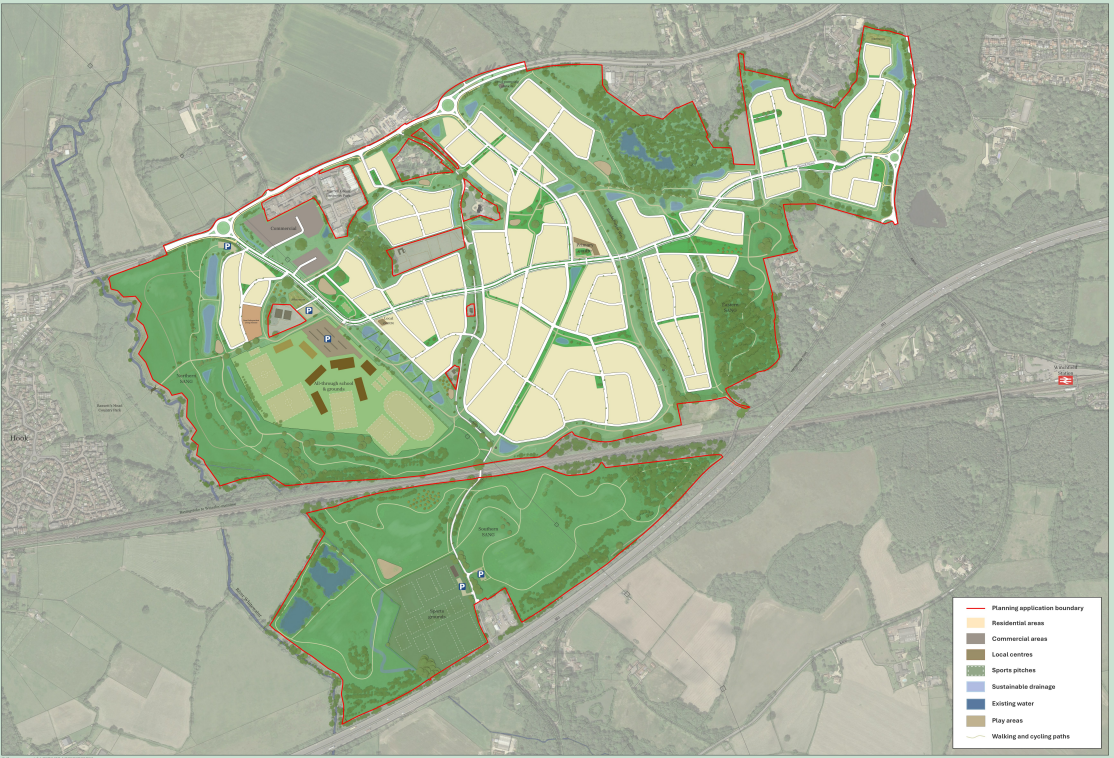
Murrell Green Master Plan 26/01201/OUT

Figure 1 – Murrell Green Master Plan

This latest proposal covers a much larger area than the earlier proposal put forward in 2017. This proposal covers 184 hectares (455 acres) or the equivalent of 258 football pitches – a huge area. The application form proposes is for a total of 2,160 dwellings broken down into 1,188 market units, 562 units for social rent, 302 affordable ownership dwellings and 108 self-build. This is roughly the scale of the current Hartley Wintney village which is about 2,300-2,400 households of the 2,600 households in the parish.

The proposal also includes employment land for commercial and business uses, space for a local centre and a larger primary centre to accommodate shops and community uses and potentially healthcare. The proposal also includes provision for a nursery/pre-school, 3-form entry primary school and an 8-form entry secondary school.

Some of the existing green space is also to be designated as a Suitable Alternative Natural Greenspace (SANG).

Why is Hart Vulnerable?

Hart does have a local plan in place running to 2032. However, much of the development in the plan was front-end loaded and the Labour Government increased Hart’s Local housing “need” to 771 dwellings per annum from the Local Plan figure of 423 dpa. The combination of the front-end loading of the Local Plan, the extra housing “need” and the Council’s lackadaisical approach to reviewing the Local Plan means Hart no longer meets its 5-year land supply target.

Moreover, back in 2017 the Council appeared to be edging towards favouring the earlier Murrell Green development.

Grounds for Objection

Despite Hart being vulnerable, there are still several grounds for objection to the proposal. Readers may wish to use these ideas for inspiration for their own objections that have to be made to Hart Council by 13 August 2026. In summary the grounds for objection are:

  • Landscape, Character and Coalescence
  • Environmental
  • Transport and Traffic
  • Infrastructure and Local Services
  • Economic Viability

Landscape, character, coalescence

The rural nature of the fields between Hook and Hartley Wintney are almost all developed under the proposal that effectively leads to coalescence of Hartley Wintney and Hook. The huge size and scale of the development is out of character to the local area.

The proposal lies entirely outside any defined settlement boundary and is therefore in the open countryside. Policy NBE1 (Development in the Countryside) of the Hart Local Plan states that development in the countryside will only be supported in a limited number of defined circumstances. A major new settlement of 2,160 dwellings does not fall within any of those exceptions.

Policy NBE2 (Landscape) requires development to protect and where possible enhance the landscape character of the District. The proposal would fundamentally alter the rural character of the land between Hook and Hartley Wintney and would result in the physical and visual coalescence of the two settlements.

Key View 3 from the B3016 in the Winchfield Neighbourhood Plan is violated. The spirit of Distinctive View E in the Hartley Wintney Neighbourhood Plan is also violated which calls for the preservation of the rural approach to the village and calls for coalescence to be prevented.

I therefore object on the grounds that the proposal is contrary to Policies NBE1 and NBE2 of the Hart Local Plan and the relevant policies of the Winchfield and Hartley Wintney Neighbourhood Plans.

Environmental

About 115 of the total 184 hectares is classified as Best and Most Versatile land (Grade 2 or 3a). This land would be lost to development in contravention of NPPF paragraphs 187 and 188. The Environmental Statement non-Technical Summary (p32) within the Murrell Green planning application states the loss of so much land to development will be a permanent major adverse effect.

The proposal identifies 66 Sites of Importance to Nature Conservation (SINCs) within 2km of the site, with seven of them within the site boundary. There are also six Sites of Special Scientific Interest (SSSIs) within 2km and the site is within 2km of the Thames Basin Heath Special Protection Area (SPA). Adding 2,160 extra dwellings in the area will no doubt put all these sites under stress.

The mitigation is to propose 58 hectares of Suitable Alternative Natural Greenspace (SANG). However, much of the SANG is placed on former landfill (see section 4), see Figures 2 and 3.
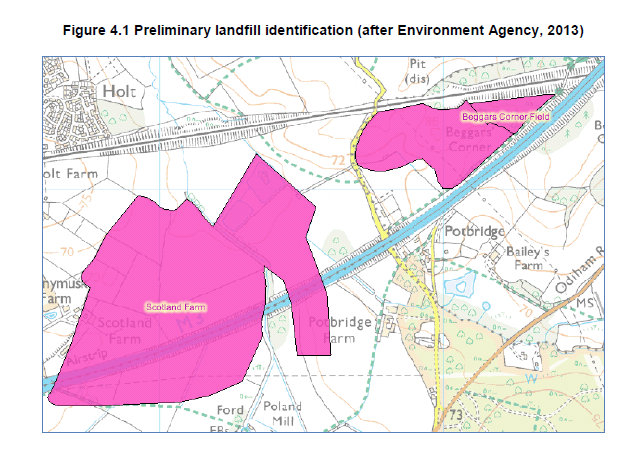
Murrell Green SHL 167 former landfill site Beggars Corner. 26/01201/OUT

Figure 2 – SHL 167 former landfill site Beggars Corner
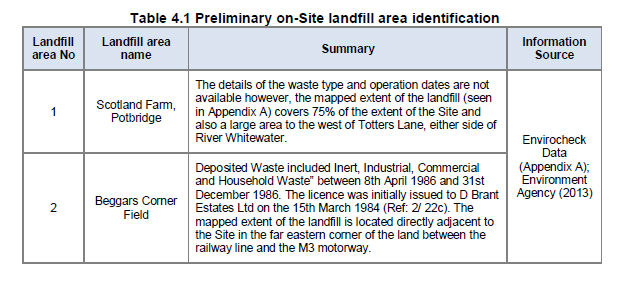
Murrell Green HL 167 Landfill details Beggars Corner. 26/01201/OUT

Figure 3 – SHL 167 Landfill details Beggars Corner

It is not known what is in some of the landfill and at this stage, the developer has not carried out detailed ground investigations. This presents a risk to future users of the SANG.

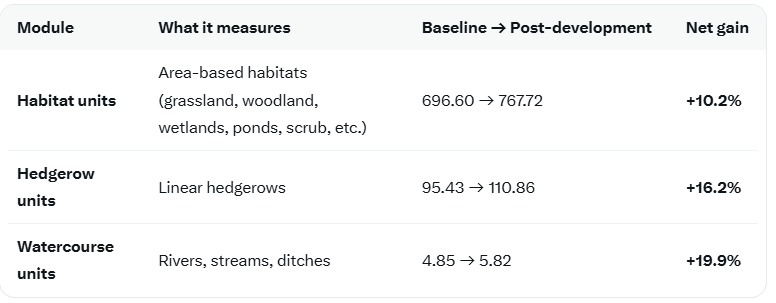
The claims on Biodiversity Net Gain (BNG) are frankly laughable. The proposal claims that gains will be made in all three areas: habitat, hedgerow and watercourse units (see Figure 4).
Murrell Green Biodiversity Net Gain Claims. 26/01201/OUT

Figure 4 – Biodiversity Net Gain Claims

The proposal starts with a baseline of 696.6 habitat units in its baseline assessment. It its stage 1 assessment (section 2.5.3) it admits 534.07 of those units (essentially the fields) will be lost. After allowing for improvements to the SANG, the loss falls to 196.15 units, although it has to be said that most of the area remains as grassland as before and the proposed orchards are not visible on the map. Then the whole-site proposal miraculously increases the habitat units to 767.72, an increase of 10.2% without giving an itemised list of how they achieved this. By pure coincidence, they have to achieve more than 10% net gain across all three modules to meet planning rules. This looks like a huge fudge that does not stand up to scrutiny.

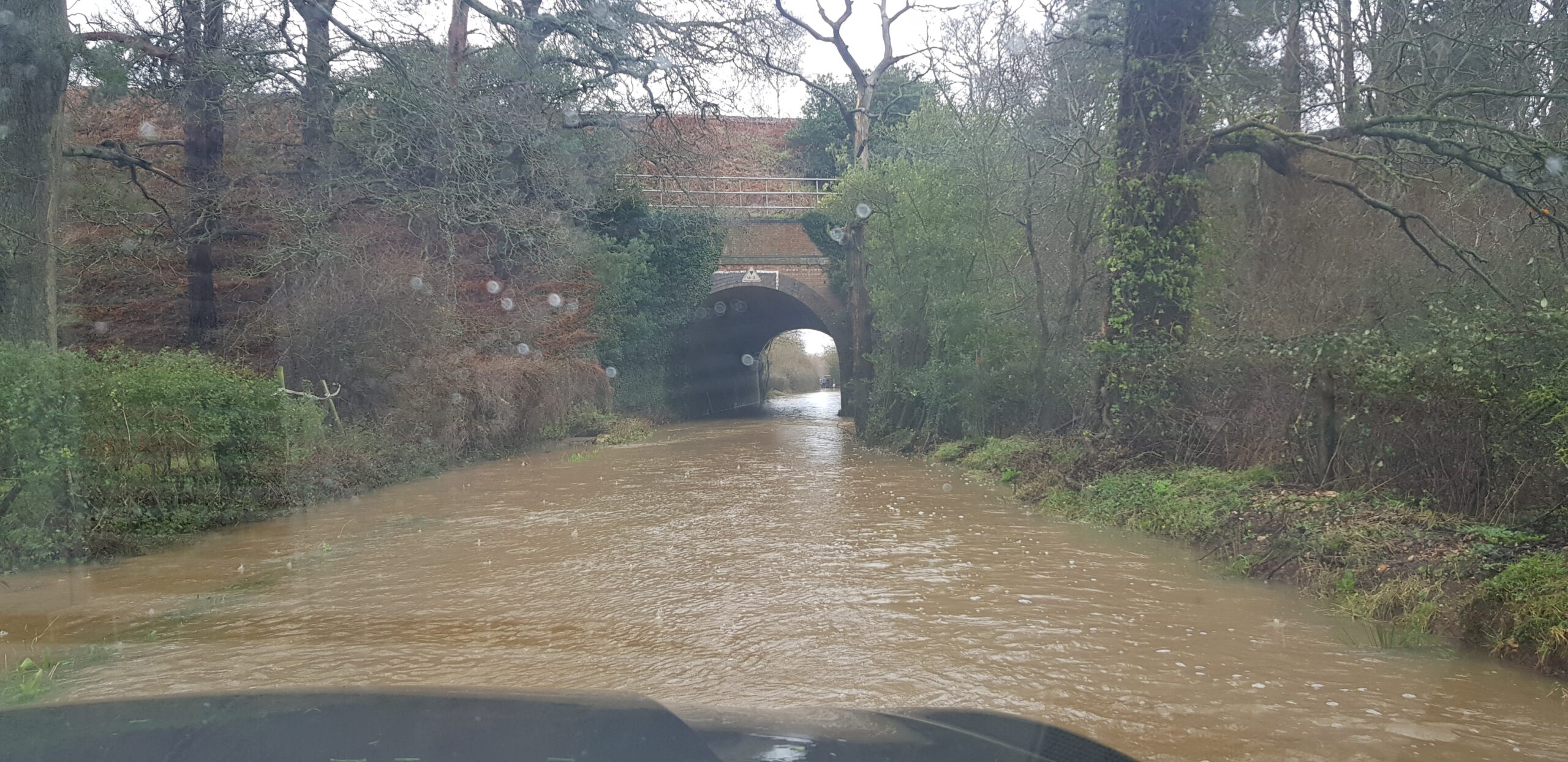
In addition, it appears that the only access to the southern SANG, south of the railway line is via the very narrow Totters Lane over the railway bridge. It is not at all clear the road and bridge can handle the extra traffic.

Policy NBE3 (Thames Basin Heaths Special Protection Area) and Policy NBE4 (Biodiversity) of the Hart Local Plan require development to protect and enhance biodiversity and to ensure no adverse effect on the integrity of the SPA. While a SANG is proposed, significant parts of it are located on former landfill of uncertain composition, and the Biodiversity Net Gain calculations appear to rely on optimistic and poorly evidenced assumptions to reach the statutory 10% target.

I therefore object on environmental grounds, including conflict with Policies NBE3 and NBE4 of the Hart Local Plan and the NPPF.

Transport and Traffic

The Murrell Green proposal includes the provision for two new roundabouts and a new T-junction on the A30 and a new roundabout on the B3016. Of course, the addition of 2,160 extra houses, probably over 4,000 cars will increase traffic on both roads leading to more congestion in Hartley Wintney and Hook. No mention is made of the need to improve the junctions of the B3016 with the A30 and A287, or the railway bridge on Totters Lane. Both are currently difficult T-junctions and will no doubt require improvement or converting to roundabouts to remain safe. The developer has not put a cost on the required improvements. The developer only commits to “proportionate contributions”.

The original 3-way roundabout at the A30/A327 junction cost £2.5m in 2015. With inflation that would probably cost £3.5m in today’s money. The proposed T-junction and three roundabouts plus the two extra probably required could easily amount to a cost of £20m.

No quantitative assessment has been made of the impact of this development on Winchfield or Hook railway stations. There is no assessment of the current or future capacity of mainline trains up to London, peak hour passenger demand, platform capacity or car park capacity. It is proposed there might be electric bike hire or a 30-minute bus service to connect to Winchfield station. No financial commitment has been made for any physical works that may be required. We might expect car park and station improvements to cost £8m.

I therefore object to the Murrell Green planning application on the grounds the transport and traffic proposals are inadequate and unfunded.

Infrastructure and Services

The developer has made provision for some non-domestic buildings on site but has not made explicit provision for a new doctor’s surgery. There is only a vague commitment to providing “proportionate financial contributions” for primary care. This is insufficient as the Whitewater Health serving the public from sites in Hook and Hartley Wintney is already overstretched. The cost of a proper surgery could easily run to £3m.

The Murrell Green planning application identifies gaps in capacity for both water provision and disposal of foul sewage. And proposes off-site reinforcement for water and a new foul water pumping station. The responsibility for funding much of this work will fall on the water companies. However, the cost of the on-site pumping station would fall on the developer and we might expect the cost to be around £5m.

As previously documented, there is a high-pressure gas main running through the site. This time the developer is planning to divert the gas main but is only budgeting £2.1m +VAT for the works. This is the same amount as they suggested in 2017, so already looks like a low-ball estimate. Data from the US shows the cost of pipelines around $12.1m per mile. The proposed diversion is about a mile long, so this suggests a cost in the region of £9m, probably higher in the UK.

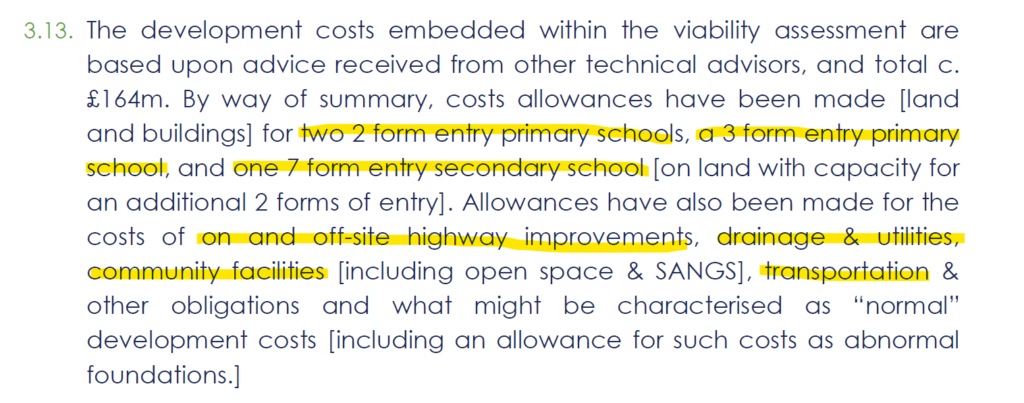
The Master Plan shows land provision for an “all-through” school consisting of a nursery, up to 3-form entry primary school and an up to 8-form entry secondary school with up to 1,200 places. In the Heads of Terms, the developer only commits to providing “proportionate financial contributions” with no actual figure mentioned. However, North Whitely School (900) places cost £52m. Scaling this up to 1,200 places gives £69m. Adding extra for the 630-place primary school and nursery could easily take the total to £110m. Relying solely on “proportionate contributions” creates a significant risk that the school will be under-funded or delayed.

I therefore object to this proposal on the grounds that the local infrastructure cannot cope with the additional 2,160 dwellings and the mitigation is inadequate and underfunded.

Economic Viability

The developer is listed as Lightwood Land Limited in the application. According to Companies House, this is a micro-company with just £256K in net assets in the latest accounts up to November 2024.

A project of this scale could easily have a Gross Development Value of over £1bn, well out of reach of such a small company. If we assume GDV of £1.1bn and a gross margin of 18%, the gross profit for this scheme would be in the order of £200m.

Now let us consider the cost of the various infrastructure promised and required to make this development work. Adding up the items above gives a total of £155m, see Figure 5.

Murrell Green Estimated Infrastructure Costs (£m). 26/01201/OUT

Figure 5 – Estimated Infrastructure Costs (£m)

In other words most of the expected gross profit will be consumed by the cost of infrastructure. We can therefore expect the developer to propose “proportionate financial contributions” well below the full cost, meaning much of the cost will fall on the taxpayer or the infrastructure will not get built at all. I therefore object to this proposal on the grounds that it is not economically viable.

Michael Gove Shakes Up Planning Rules

Michael Gove Shakes Up Planning Rules

Michael Gove Shakes Up Planning Rules

Michael Gove has sent a letter to MPs announcing a major shake up of the planning rules. Some of the changes were also reported in the Telegraph (subscription may be required). On the face of it, the changes look positive for Hart and Hart residents. Of course, the devil is always in the detail, so we will have to remain vigilant.  However, we are hopeful that these changes will finally kill off any idea that we need to build Shapley Heath. The changes are

  1. Central housing targets not mandatory
  2. Build less to take account of heritage restrictions and flood risk
  3. Not expected to build at densities out of character with existing areas
  4. Pursue gentle density in urban areas
  5. End obligation for 5-year land supply where plans are up to date
  6. Credit given for past over-supply
  7. Increase protections afforded by Neighbourhood Plans
  8. Brownfield first


Central Housing Targets Not Mandatory

According to Gove’s letter, central housing targets will become “an advisory starting point, a guide that is not mandatory”. “It will be up to local authorities, working with their communities, to determine how many homes can actually be built, taking into account what should be protected in each area – be that our precious Green Belt or national parks, the character of an area, or heritage assets.”

This means that for instance, we might be able to protect the Shapley Heath site because of its unique character and the heritage assets such as St. Mary’s Church.

Build less to take account of heritage restrictions and Flood Risk

Quoting from the letter: “Local planning authorities will be able to plan for fewer houses if building is constrained by important factors such as national parks, heritage restrictions, and areas of high flood risk.”

As mentioned above, there are heritage issues on the Shapley Heath site and of course high risk of flooding from surfacce water and groundwater across much of the site.

Not expected to build at densities out of character with existing areas

Again, according to the letter: “Local authorities will not be expected to build developments at densities that would be wholly out of character with existing areas or which would lead to a significant change of character.”

The area around Winchfield is very low density, which is part of its charm. Clearly a Garden Community of 5-10,000 houses would be out of character and change the character of the area irreparably.

Pursue gentle density in urban areas and Brownfield First

Michael Gove’s shake up of the planning rules also impacts urban areas. He says that “while more homes are needed in many existing urban areas, we must pursue ‘gentle densities’ as championed by the Building Better, Building Beautiful Commission.”

He also commits to a Brownfield First strategy: “The Government is investing to incentivise and enable brownfield development. Homes England, our housing delivery arm, is spending millions on acquiring sites in urban areas to regenerate for new housing. We are also allocating over £800m to mayoral and local authorities to unlock over 60,000 new homes on brownfield land, as part of our wider brownfield and infrastructure funding package.

This should tilt the balance towards regeneration of urban centres in Hart such as Fleet, Blackwater, Yateley and Hook.

End obligation for 5-year land supply where plans are up to date

Gove also plans to end the obligation to have a rolling 5-year land supply. “We will end the obligation on local
authorities to maintain a rolling five-year supply of land for housing where their plans are up-to-date.”

Hart’s plan is up to date. Hart’s Local Plan is front-loaded, so we had a potential issue that we might have had to find additional sites towards the end of the plan period to maintain the 5-year land supply. It seems that this issue will be resolved, further weakening any case for building Shapley Heath.

Credit given for past over-supply

Michael Gove has also proposed giving credit for past over-supply of housing. “I want to recognise that some areas have historically overdelivered on housing – but they are not rewarded for this. My plan will therefore allow local planning authorities to take this into account when preparing a new local plan, lowering the number of houses they need to plan for.”

Hart has over-delivered on housing for a number of years. Some of this is taken into account in the 5-year land supply calculation. However, this change should allow Hart to reduce the housing requirement target in future years.

Increase protections afforded by Neighbourhood Plans

Finally, changes are proposed to increase the protections afforded by Neighbourhood Plans. “I will increase community protections afforded by a neighbourhood plan against developer appeals – increasing those protections from two years to five years. The power of local and neighbourhood plans will be enhanced by the Bill.”


Overall, we view these as positive changes for Hart as a whole.


Shapley Heath Mapgate: Council map hides the reality

Shapley Heath Mapgate - Coalescence

Shapley Heath Mapgate – Coalescence

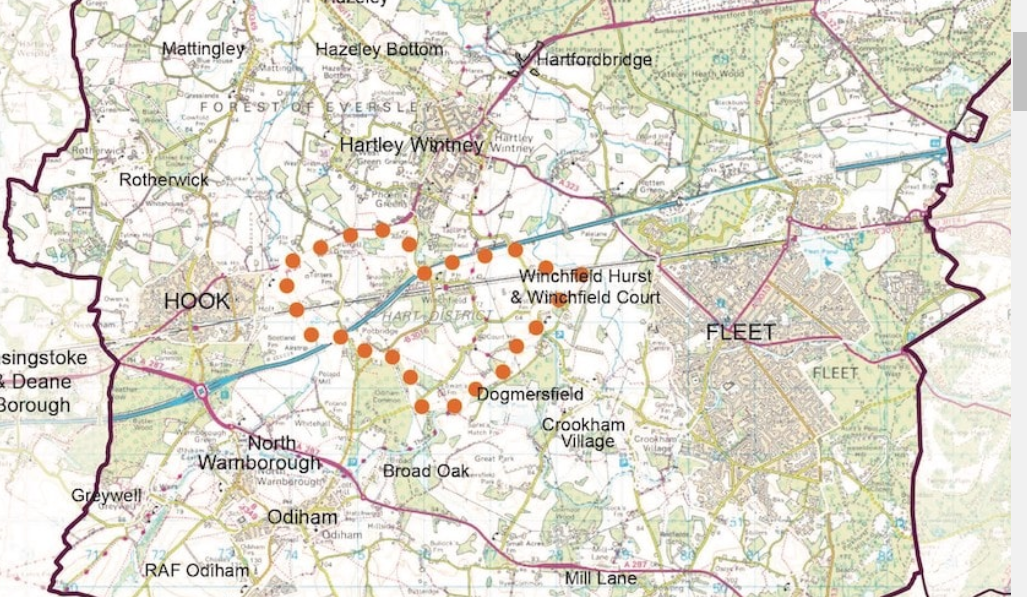
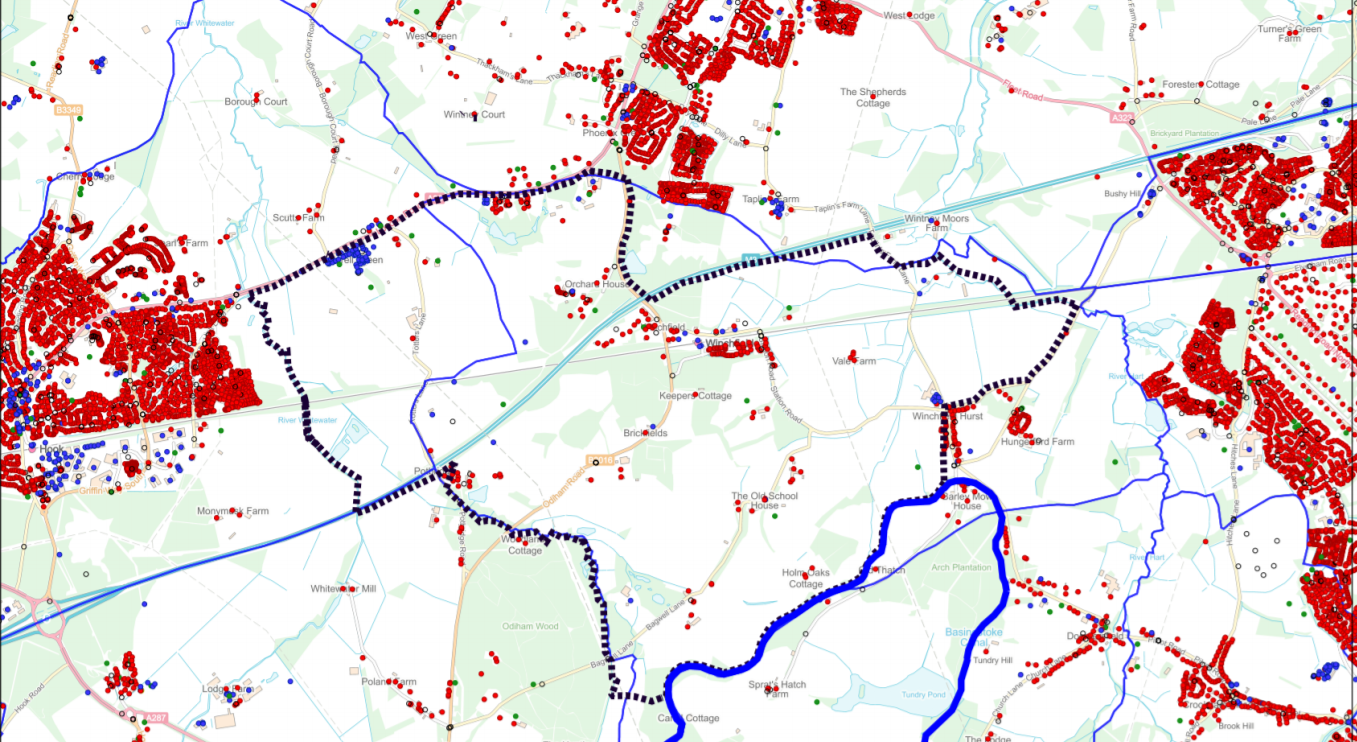
They say a picture paints a thousand words. However, sometimes, what’s missing from a picture can tell you more than what’s in it. As you may know, Hart has published a survey about the proposed Shapley Heath Garden Community. There is a map associated with the survey that is published on the dedicated Garden Community website.

Shapley Heath #Mapgate - Heart Shaped Love It

Shapley Heath #Mapgate – Heart Shaped Love It

Note the soft boundaries, the warm orange dots and the attempt to make the boundary heart shaped, so you will subliminally love it. Of course the OS map on which it is based doesn’t include the Edenbrook development on the western Fleet boundary.

To combat this propaganda, Winchfield Parish Council has published some maps of its own, showing the impact of Shapley Heath should it ever go ahead. The first, at the top of this post, shows the potential coalescence with surrounding towns and villages. If they build in the NE zone, it will effectively join Fleet to Hartley Wintney. On the other hand, if they build in the NW, around Murrell Green, then it will coalesce Harley Wintney and Hook. If they build both sides, then effectively, Fleet, Hartley Wintney, Hook and the new town will become a single, large conurbation. We have previously termed this Hartley Winchook.

Shapley Heath Mapgate: Central Land Not Available

Shapley Heath #Mapgate - Central Land Not Available

Shapley Heath Mapgate – Central Land Not Available

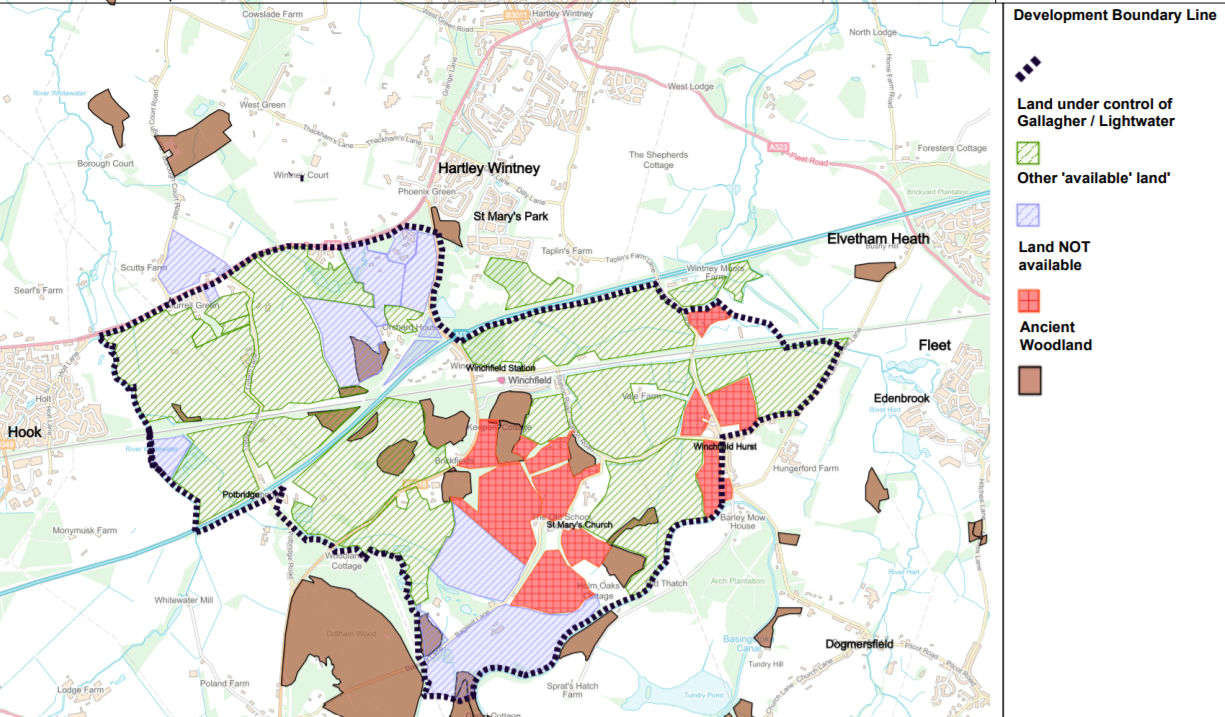
The next map shows land ownership in the area of search. The areas in green are under the control of the developers. Land that is potentially available to the developers – presumably not yet under option – is shown in blue. The red zone is land that is not and never will be under the control of the developers. Areas of ancient woodland, shown in brown, cannot be developed either.

As can be seen, there’s vast swathes of land in the area of search that cannot be developed. This means they have to build either in the NW area, the NE area or both. But none of those options allows for a single coherent settlement. All three options lead to coalescence.

Shapley Heath Mapgate: Additional Constraints

Shapley Heath #Mapgate - Physical Constraints

Shapley Heath Mapgate – Additional Constraints

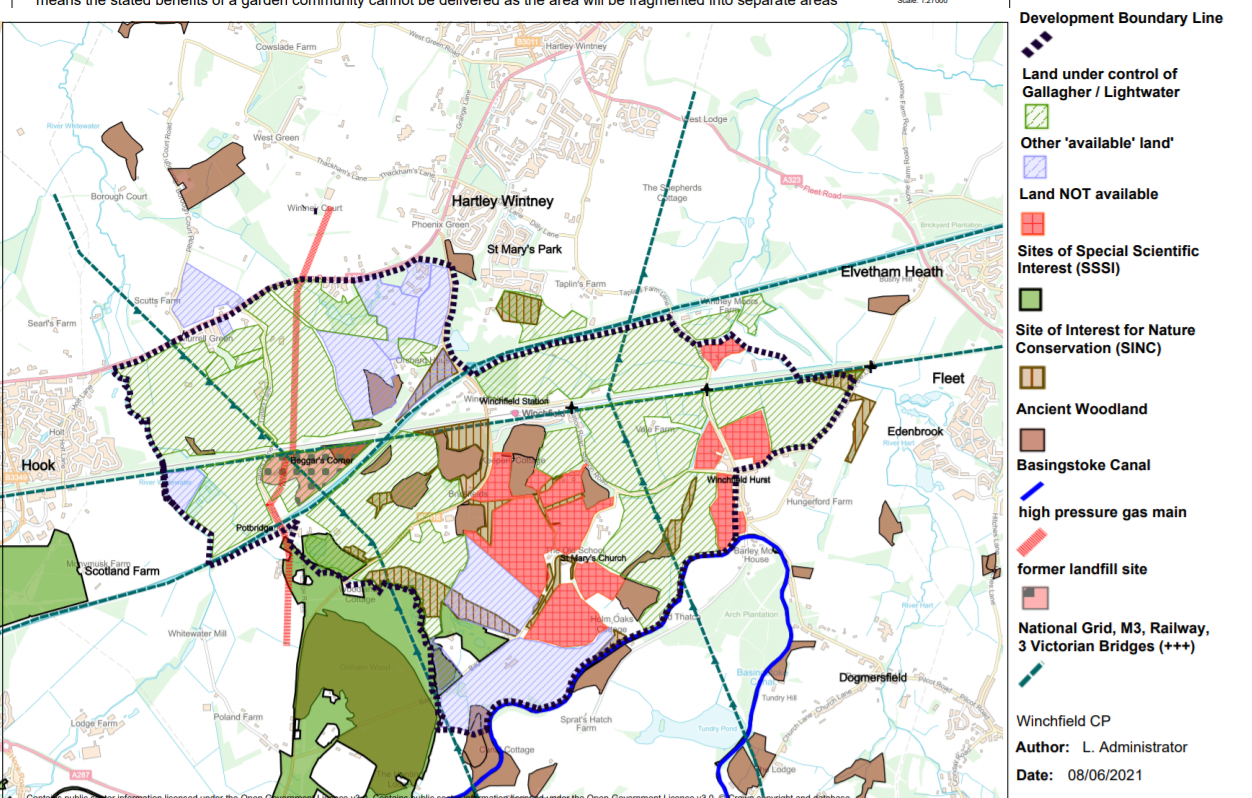
However, the constraints don’t stop there. When you add on the additional environmental items such as the Sites of Importance for Nature Conservation (SINCs) and Sites of Special Scientific Interest (SSSIs), then the area becomes even more constrained. The physical constraints of the high-voltage electricity pylons, the high pressure gas main, the M3, railway line and the former landfill all add further restrictions on what is safe or sensible to develop.

Conclusion

If you display an anodyne map to the general population, they will form one view of the site under consideration. When faced with maps that actually convey real information, then perceptions can change markedly. We wonder why Hart Council aren’t taking more heed of the Inspector’s words when he examined plans for a new town in the same area as part of the Local Plan (our emphasis):

I have a number of fundamental concerns with regard to the soundness of Policy SS3.

There is little evidence to demonstrate that a site can actually be delivered in terms of infrastructure, viability and landownership within the identified AoS.

Policy SS3 is not required for the Plan to be sound and, in light of my comments above, I consider that the most appropriate course of action would be to remove it (along with any other necessary subsequent changes) from the Plan.

I am also mindful that following further work, there can be no guarantee that the evidence would support it as the most appropriate long-term growth strategy or that Policy SS3 would be found sound.

All of these issues are known, yet the Council is pressing on spending money they don’t have, on a project we don’t need and probably won’t work anyway.

Having read this article, you might like to respond to the Shapley Heath survey. This is your chance to make known your concerns about the proposals. We have produced a handy guide with suggestions as to how you might choose to answer the freeform questions. The guide can be found on the download below. The full survey can be found here.

Shapley Heath Survey with Suggested Responses

CCH seek opt out from housing target as they build more than required

CCH seek opt out from housing targets

CCH seek opt out from housing targets

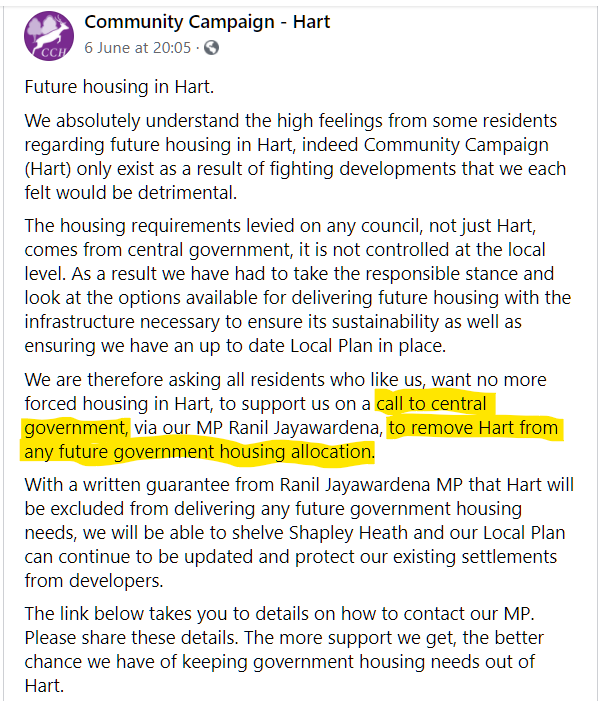
In a desperate move, CCH has launched a campaign for Hart District to opt out of the Government housing targets. The say:

We are therefore asking all residents who like us, want no more forced housing in Hart, to support us on a call to central government, via our MP Ranil Jayawardena, to remove Hart from any future government housing allocation.

Many of us have thought for some time that CCH displayed quite authoritarian tendencies. But this is virtually a declaration of independence on housing policy. Something tells us that Ranil won’t be receiving many emails.

Already building more than Local Plan Requires

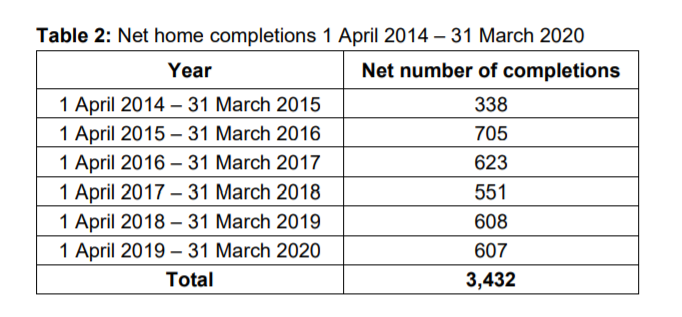
The irony in their position is that they are in power when we are building far more than required. In each of the past five years, Hart has built far more than Local Plan requirement of 423 dpa.

Hart District Annual Housing Completions to Mar 2020

Hart District Annual Housing Completions to Mar 2020

Of course, they may argue that this is because many planning permissions were granted when Hart did not have a Local Plan.

No Intention of Reviewing the Local Plan

But looking forward, the most recently published housing target for Hart is 286dpa. Yet, despite being asked, they have no intention of reviewing the Local Plan to take advantage of this new, lower figure.

So, we are building more than is required by both the Local Plan and more than the Government housing target.

Shapley Heath will Add to the Excess Building

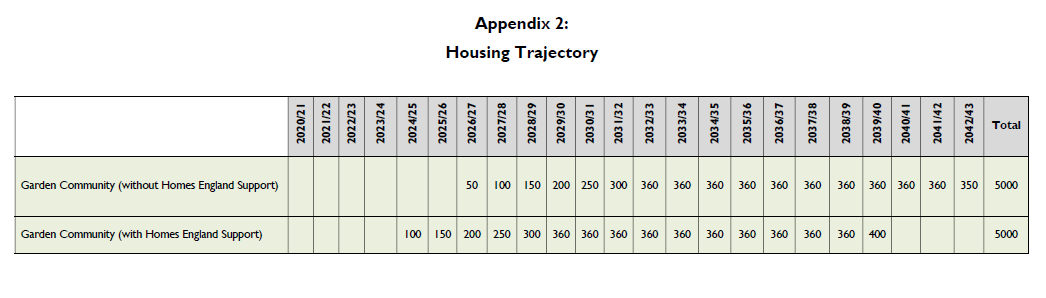
Yet, they are still planning Shapley Heath. The most recent housing trajectory for this project has housing delivery starting in 2024. The steady state housing trajectory is 360 dpa. Even on its own, Shapley Heath delivers far more than the Government housing target.

Shapley Heath Housing Trajectory Sept 2020

Shapley Heath Housing Trajectory Sept 2020

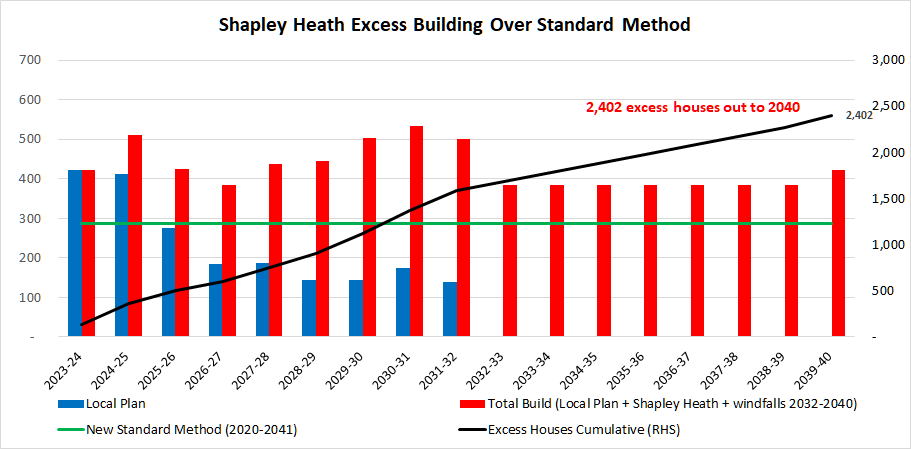
All of the housing delivered by Shapley Heath will be in addition to the Local Plan.

Shapley Heath in addition to Local Plan

Shapley Heath in addition to Local Plan

Adding it all up, over the period that Shapley Heath will be built, it will deliver about 2,400 houses in excess of requirements.

CCH seek opt out from housing target as they plan to build even more

CCH seek opt out from housing targets as they plan Shapley Heath to build more than Local Plan requirement

Perhaps it would be better for CCH to spend their time getting their own house in order instead of indulging in ridiculous grandstanding.

Shapley Heath Survey

You might like to respond to the Shapley Heath survey. We have produced a handy guide with suggestions as to how you might choose to answer the freeform questions. It can be found on the link below. The full survey can be found here.

Shapley Heath Survey with Suggested Responses


Hart Council to spend £406K on Shapley Heath White Elephant next year

In questions put to them at their meeting on 28 January, Hart Council admitted it planned to spend £406K on the Shapley Heath white elephant in FY21/22. This comes at a time they are secretly planning cuts elsewhere. The question is as follows:

What is the anticipated level of spend on SHGV over each of the next 2 financial years?

They don’t know how much they are going to spend in FY22/23. This comes at a time when the Council is considering a confidential paper about cuts to services because of forecast deficits. They forecast a deficit of £381K in FY21/22 and an eye-watering £1,081K in FY22/23.

No real plans for regeneration of our urban centres post-Covid

We also asked them to set out their plans and budget for regenerating our urban centres after the Covid-19 pandemic.

Many of our local businesses have struggled during the pandemic and some have sadly had to close, leading to permanent change to our high streets. What is the action plan and budget over the next 2 financial years to help Fleet and other urban centres recover and regenerate post-Covid?

The answer was fairly vague and somewhat misleading. They have received £1.947m from Government for business support and recovery. Apparently £500K is for the recovery component. This money has to be spent by 31 March 2022. The only paper we can find about their recovery plans can be found here. Most of the actions are completed and include the over £100K spent on the ill-fated closure of Fleet Road. It appears as though most of the remaining money is going to be spent by the Council on itself. Projects include an employee assistance programme, replacing the telephony system and SharePoint training. Whilst these might be worthy projects, they fall far short of what is required.

Our town centres have been permanently changed by Covid-19, and will need very significant investment to re-establish themselves as thriving communities. We can see from this that the Council is prioritising a white elephant project we don’t need over our existing businesses and communities.

Justification for Shapley Heath White Elephant Spending

We did ask them about their justification for continuing to spend at such high level on a project we don’t need when cuts are being contemplated elsewhere:

The latest budget monitoring statement (s4.3) considered by Cabinet in early January, shows a forecast overspend of £972K in 2020/21. The draft budget (s.9.4) considered by O&S shows a deficit of £381K for 2021/22 and a further £1,081K deficit for 2022/23. How can you justify hiring full-time staff and continuing to spend vast sums on an unnecessary Garden Community when core services are at risk of being cut?

The initial answer was very defensive. It was only when pushed that Councillor Cockarill provided more detail.  The money they plan to spend on Shapley Heath is supposed to be coming from Central Government. However, they have set aside money from Reserves to fund Shapley Heath.  Councillor Cockarill did admit that they might have to “reassess the priority” of Shapley Heath if the Government grant doesn’t materialise.

Other Questions

We did ask other more technical questions:

  • Hart’s compliance with the Housing Delivery Test.
  • Whether they are considering an early review of the Local Plan to take advantage of the new lower Government targets.
  • If they will publish monthly project plans and status reports on the Shapley Heath projects.

The questions and answers can be found on the clips below.

Council Adopts Hart Local Plan

Council Adopts Hart Local Plan

Council Adopts Hart Local Plan

It’s been a long time coming, but Hart Council has finally adopted the Hart Local Plan. This took place at their first virtual meeting that happened at 7pm on 30 April 2020.

The meeting was broadcast on Hart’s live streaming page: https://www.facebook.com/HDCLiveStreaming/

However, these videos are often removed shortly after broadcast.  So we have downloaded it, and uploaded it to YouTube for posterity.

We can all sleep relatively easily now that we have a Local Plan. This plan has had Policy SS3 removed from it. However, we need to remain vigilant that the Council doesn’t seek to bring back the unnecessary Shapley Heath Garden Village at a later point.


Breaking News: Inspector approves Hart Local Plan

Breaking News: Planning Inspector approves Hart Local Plan

Inspector approves Hart Local Plan

The planning inspector has approved the Hart Local Plan.

The announcement has been made by Hart District Council and can be found here.

The Inspector has found the Local Plan to be sound and legally compliant, subject to some recommended changes. It will go before the Council for formal adoption in March.

The full Inspector report can be found here.  We will update this story as we digest what the Inspector has said.

The appendix containing the main modifications can be found here.

[Update 1]

  • Policy SS3 has been removed, so further confirmation of no new settlement in Shapley Heath/ Winchfield for the time being.
  • Reiteration in para 181 that future reviews of the Local Plan must look at all options including regeneration:

Nonetheless, the Council will need to ensure that all options for meeting future housing needs are considered fully in future reviews of the Plan, including the potential for regeneration.

  • Emphasis added to MM121 to make clear that all reasonable growth options should be considered and evidenced. This refers to the flawed SA that was submitted to the Examination to try and justify the new settlement:

All reasonable growth options, including the potential for a new settlement, would need to be fully considered and evidenced in a future review of the Plan or a subsequent DPD.

  • Changes to main modifications 70 and 71 to make clear that mixed residential and commercial use properties within town centres will be permitted. This will also help facilitate regeneration.  CCH should take note.
  • In light of recent events, it is also good to see that the vision has been updated to include a reference to flood risk:

New development will have been built to high environmental and design standards. It will have been designed and located so that it is safe from flooding and has not increased the risk of flooding elsewhere and includes measures to meet the challenges of climate change.

[/Update]

Latest CCH newsletter released

CCH have released their latest newsletter. They follow their usual path of being economical with the truth.  There are some quite astonishing claims in there, that need to be answered.

False Pale Lane Claim

They claim:

The Local Plan has already demonstrated its value by being part of the successful defence against inappropriate urban extensions in Hook and most notably at Pale Lane, on farmland adjacent to Elvetham Heath. Even as a draft, it has significant weight when considered at a planning appeal.

But the inspector said that the emerging Local Plan only carried “moderate weight“. CCH don’t mention that the most important piece of evidence was the Hartley Wintney Neighbourhood Plan, whcih carried “significant weight”.

Housing Numbers Warning

They say:

The very calculation the government use to reach our `Objectively Assessed Housing Need’ is expected to be radically modified in the near future. Any material change in this calculation of our housing numbers would render the Local Plan `out of date‘ and require Hart to fundamentally review its Local Plan….

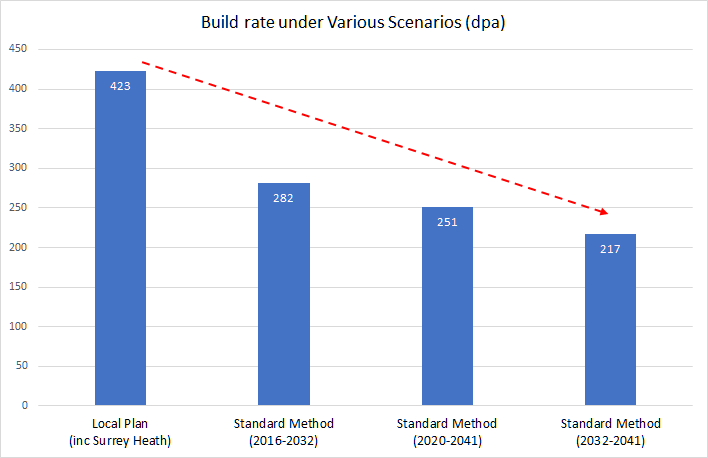
There is some truth in the claim that Hart will run short of housing around 2025/26, as we covered here. But there is no evidence that the new formula for calculating housing need is going to be “radically modified”. Indeed their implication that housing numbers will rise is false.  In fact, if Hart were to conduct an early review of the Local Plan, our annual housing target would be reduced from 423 dpa to 251 dpa. But, in Hart’s answer to our latest question, they have ruled out an early review.

Shapley Heath Justification

CCH then go on to justify the need for Shapley Heath:

That is why the Community Campaign support the approach of carefully evaluating the possibility of a new eco-friendly garden village within walking distance of Winchfield station. Only if needed, this development could be used to deliver the bulk of any additional housing that may be required by central government in the period from 2026 onwards. As such, it must be very carefully planned to deliver all the necessary infrastructure.

Note how Shapley Heath has now become “eco-friendly”, despite the fact it is entirely unnecessary and building it will likely emit 1m tonnes of CO2.

CCH Newsletter: Fact Checking the myth busting

CCH’s newletter includes a section on “myth-busting” Shapley Heath.

First on housing need.

A new settlement is not needed as part of the new Local Plan. This is all about funding (with government grant support) a project to see what is possible. If the future government housing targets do not require such housing to be built – it will not be built. This is an insurance policy against Hart having to take on a higher housing quota in a few years’ time.
If they really wanted an insurance policy they would be conducting a immediate review of the Local Plan to take advantage of the lower housing target from the latest Government methodology.
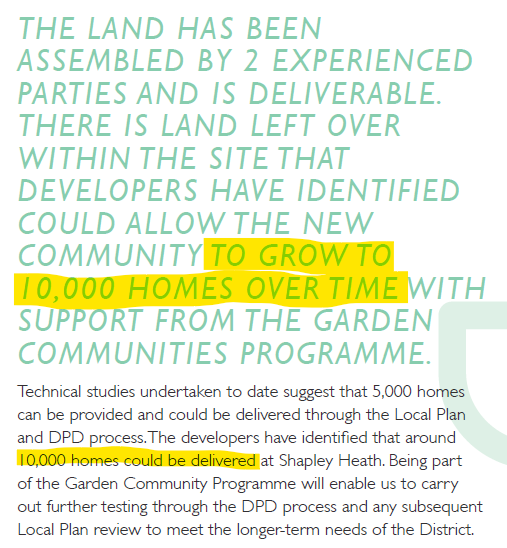
Then on the size of Shapley Heath.  They claim that they are only considering a development of 5,000 houses. But the bid they submitted to Government was for up to 10,000. The flawed viability assessment was for 5,300 houses.

Shapley Heath: Vision Document 10000 houses.

Shapley Heath: Vision Document 10000 houses

Shapley Heath Garden Village Viability Summary

Shapley Heath Garden Village Viability Summary

So, they are wrong again. They then go on to make some false claims about infrastructure.

Bolt-on urban extensions don’t deliver infrastructure. They don’t present the economies of scale to permit major road improvements, nor building a new secondary school, or doctors surgeries.

The flawed viability assessment for Shapley Heath pointedly does not include provision for healthcare.

Shapley Heath Garden Village Viability Assessment Infrastructure Costs

Their plans simply do not stack up to even cursory scrutiny. They go on to make extraordinary claims about the features of Shapley Heath.

Shapley Heath’ is being investigated using government grant funding designed to promote eco-friendly garden villages. This is about learning from the disasters of the past and building semi-rural communities which are sympathetic to and supportive of, the local and wider ecology and climate. There will be integrated transport, rainwater harvesting, centralised heat and power plants, carbon efficient housing design, an emphasis on renewables and truly sustainable living.

Let’s for a moment ignore the fact that this isn’t needed, so the 1m tonnes of CO2 produced during construction will also be an unnecessary. But even the Planning Inspector criticised the claims for a district heating system.

Option 1b has been ranked the highest under the category climate change. This is as a result of the potential for the proposed new settlement to deliver a district heating system. However, there is little evidence to suggest that this is a feasible or realistic option that is being actively pursued by the site promoters. I consider this raises doubt about the appropriateness of such a ranking.

The viability study only made allowance for standard build costs. No allowance was made for the additional costs of “carbon efficient housing design”. Their claims are simply marketing fluff that aren’t backed up by anything.

Ostrich approach to Fleet Revitalisation

The CCH newsletter then goes on to discuss Fleet. They claim that Fleet “isn’t all that bad”. This is despite the council’s own bid for Future High Street funding saying:

  • The council quotes a prior report that says a “do nothing scenario would not be viable in Fleet”.
  • Fleet faces a number of key challenges.
  • 88% of people say Fleet doesn’t meet their retail and leisure needs.
  • 52% of people would not recommend a visit to the town centre.
  • 67% think the poor retail offer reflects badly on the town centre.
  • The confidence of local businesses is extremely low.
  • Fleet unable to compete with neighbouring towns.
  • Major retailers identify Fleet as an investment risk.
  • Lack of affordable housing is identified as a key issue by 27%

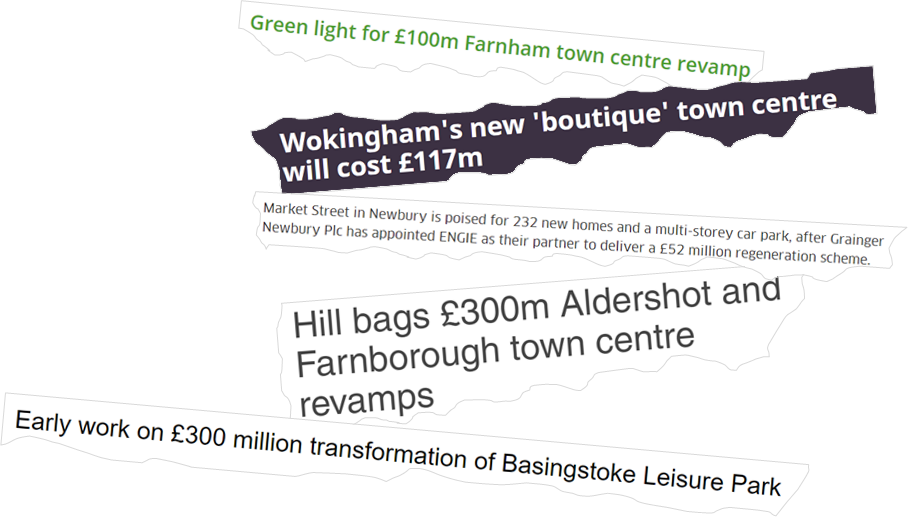
Fleet is falling behind its local competitors. Most of the surrounding towns are attracting hundreds of millions of pounds of investment. Fleet isn’t getting anything.

CCH newsletter ignores Fleet falling behind neighbouring towns

Fleet falling behind neighbouring towns

CCH Newsletter – Regeneration untruths

CCH then go onto claim that revitalising our town centres must mean “high-rise” flats. Nothing could be further from the truth. Indeed high-rise developments do not deliver good places to live, and we oppose them. They offer no vision on how to address the issues facing Fleet. We will give further details on our ideas in further posts.


In the meantime, please do challenge CCH to come clean on their mendacious claims.


#StormDennis dissolves daft Shapley Heath idea

"<yoastmark

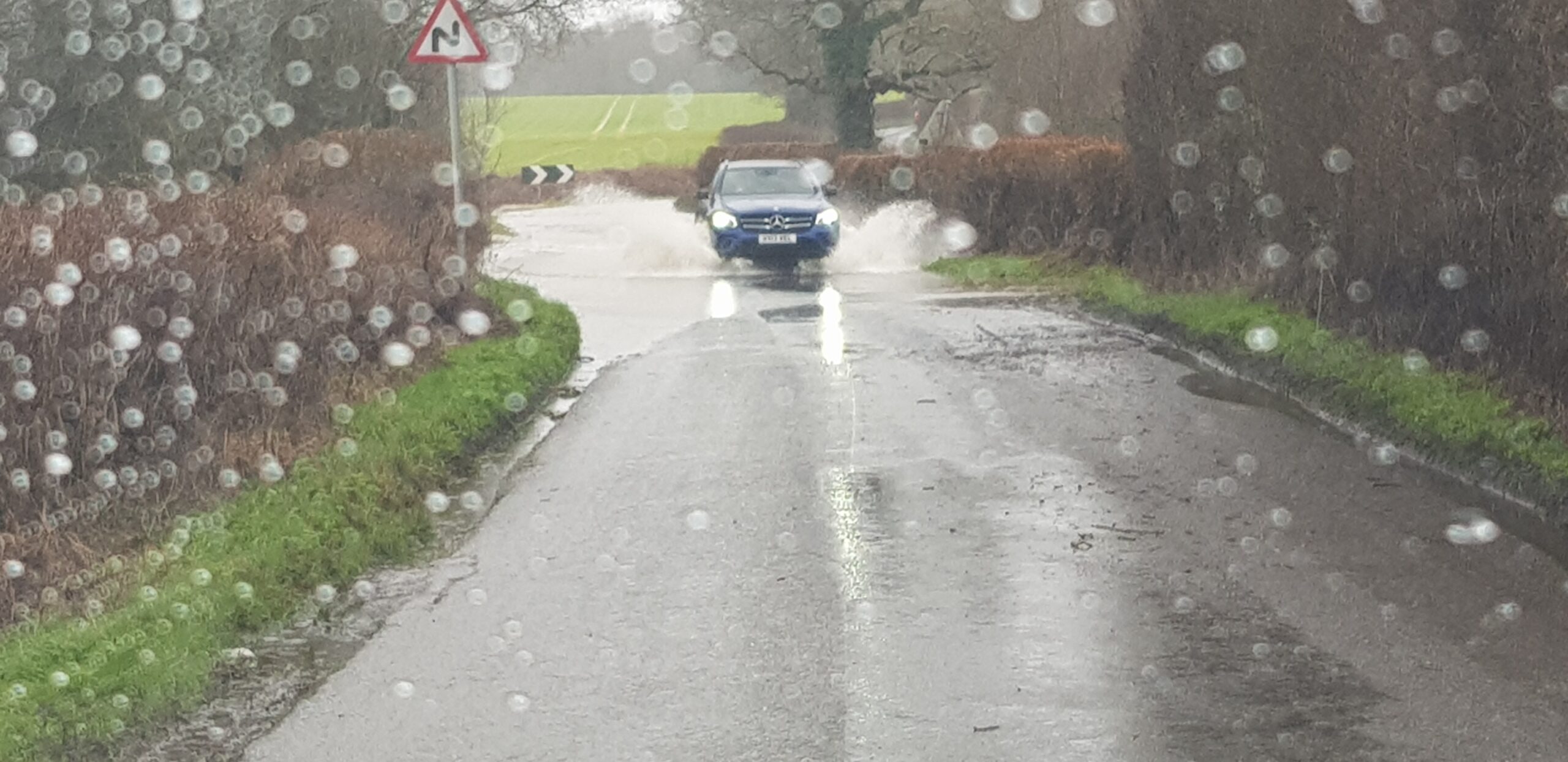
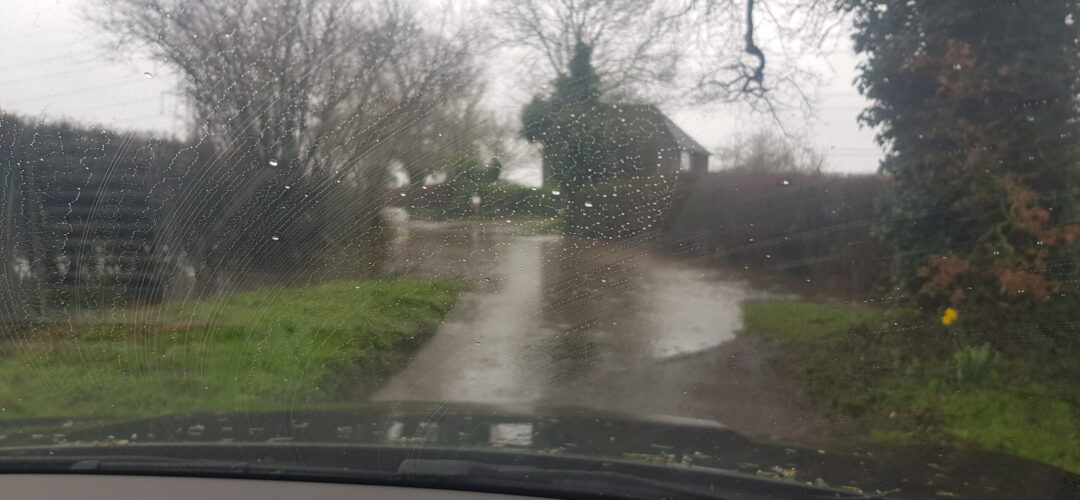
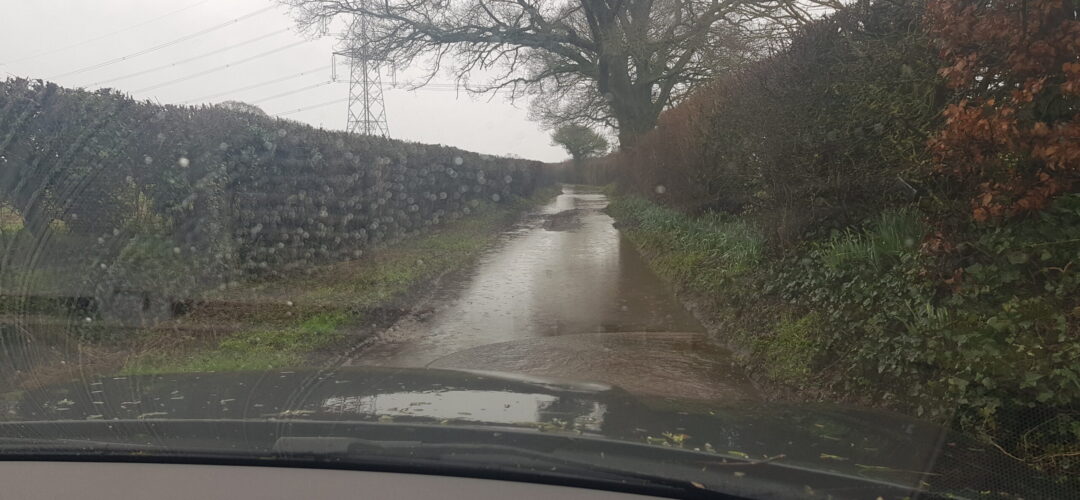
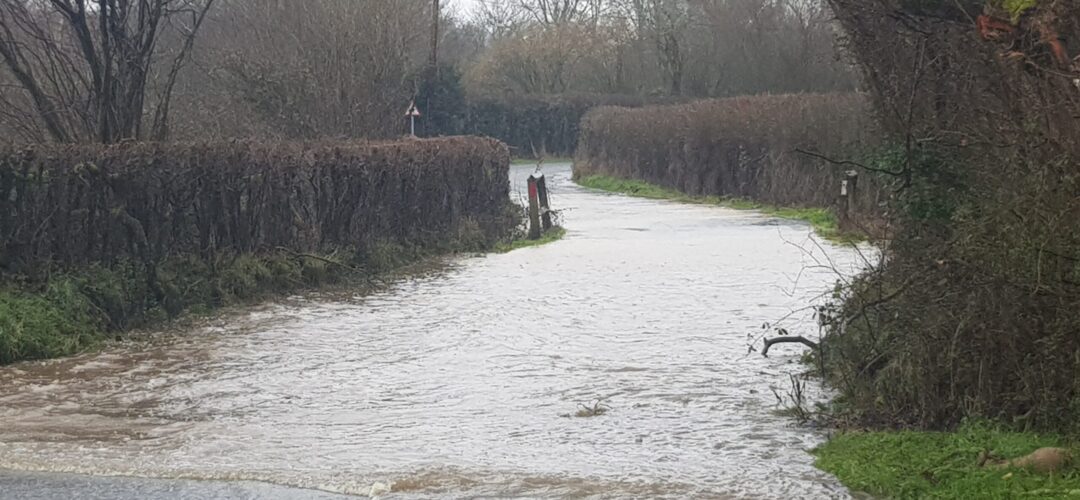
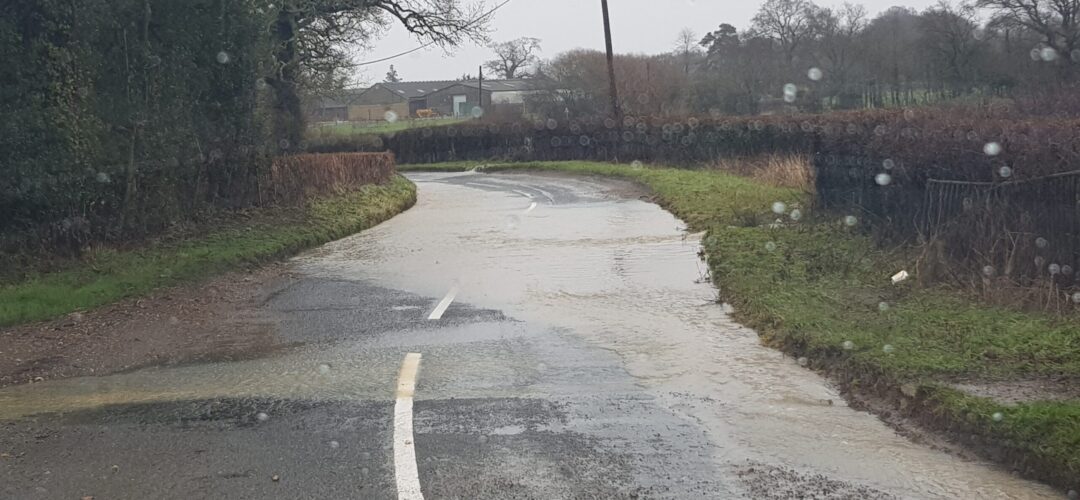
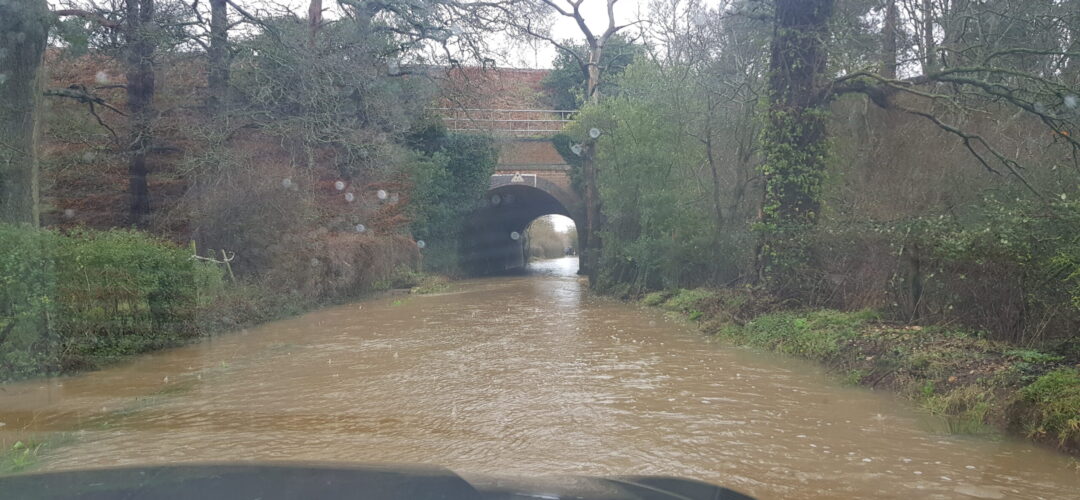
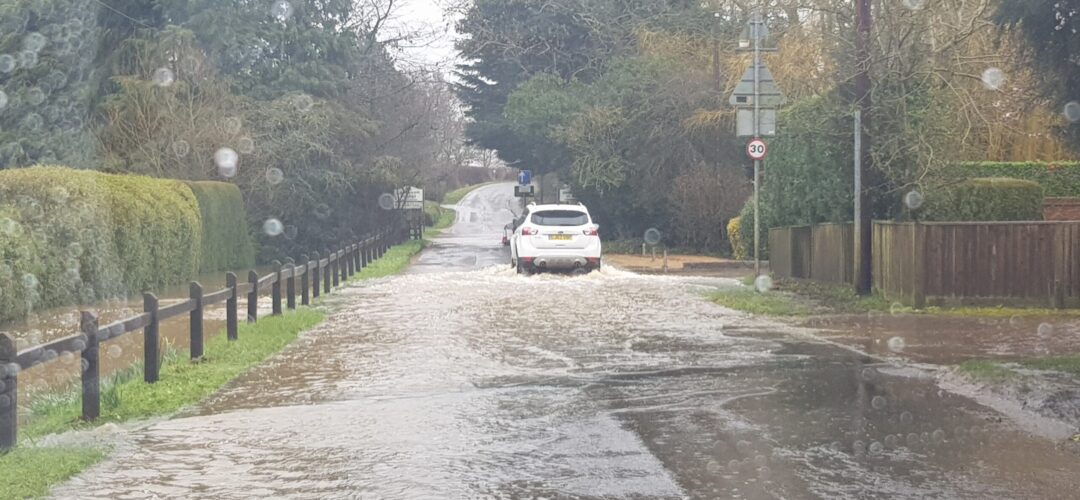
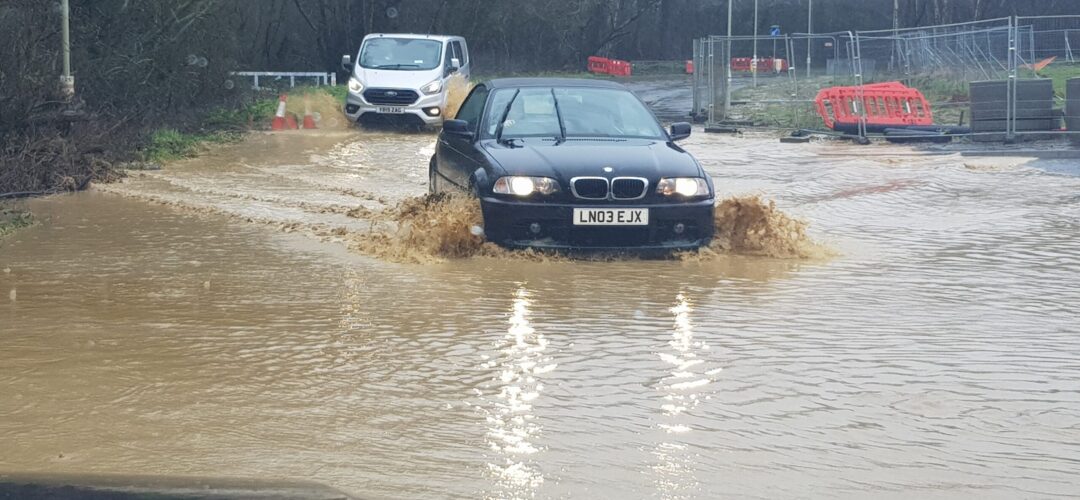
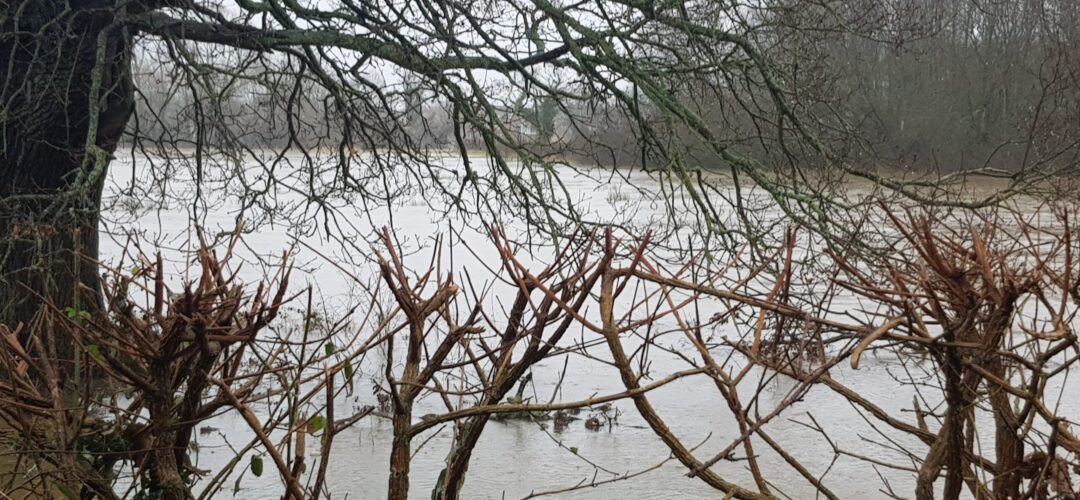
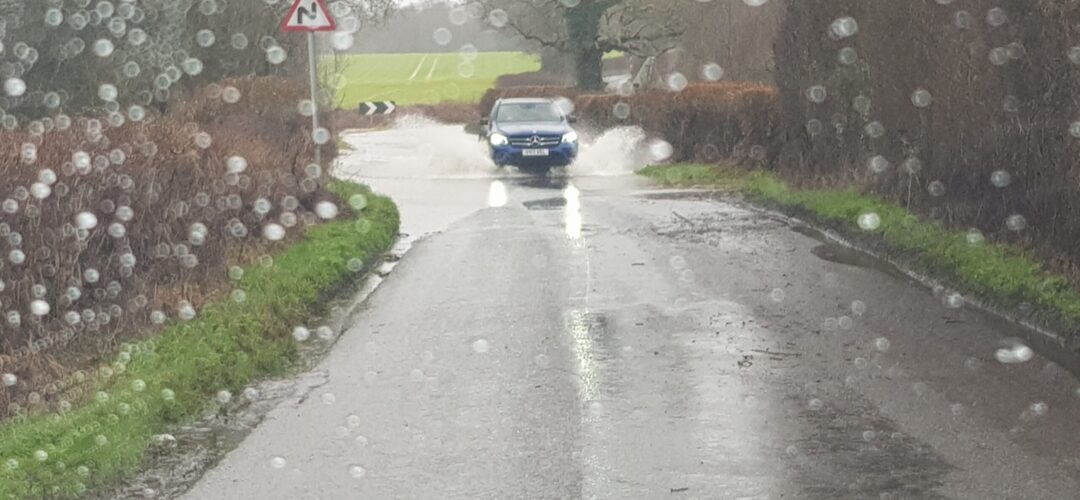
#StormDennis has taken its toll on Hart District. As far as we can tell, the worst hit area is around the mooted Shapley Heath/ Winchfield new town.  Here we have evidence of yet another of these supposed 1 in 30 year events. We drove around there this morning and found:

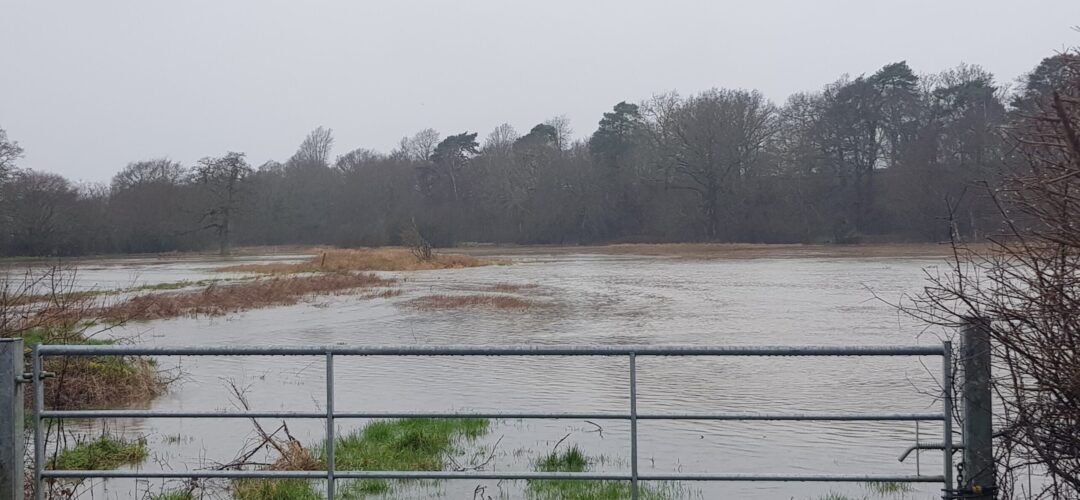
  • The river Whitewater had flooded by the A30 opposite the Crooked Billet. This is the area that is supposed to be Suitable Alternative Natural Greenspace (SANG). The sort of area earmarked for country rambles and dog-walking. Definitely not water-skiing.

  • Totters Lane flooded at the top for quite a distance
  • Bagwell Lane in Winchfield flooded
  • Station Road flooded
  • Pilcot Road in Dogmersfield flooded
  • Hitches Lane in Crookham Village flooded near the new roundabout for the Grove Farm development. Who knows how the new residents are supposed to get out of their new houses.
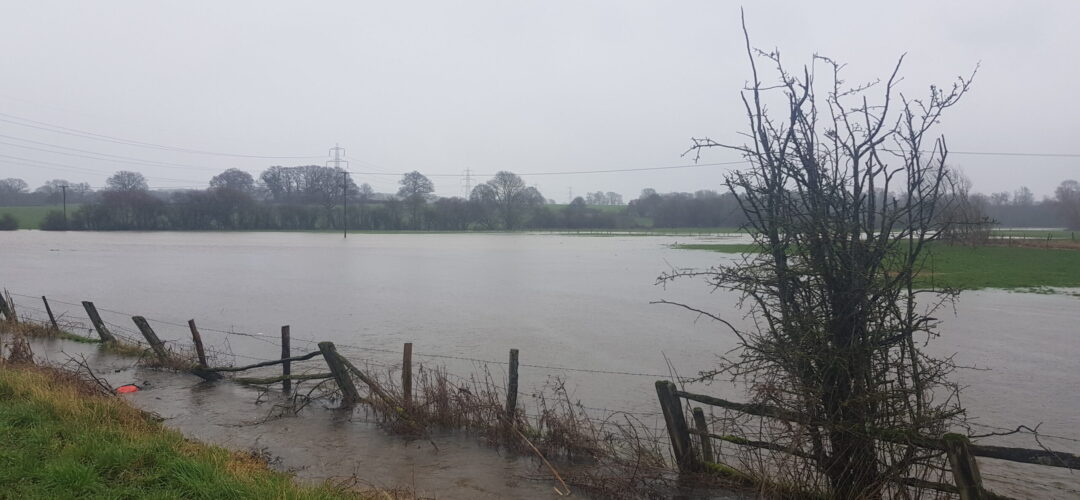
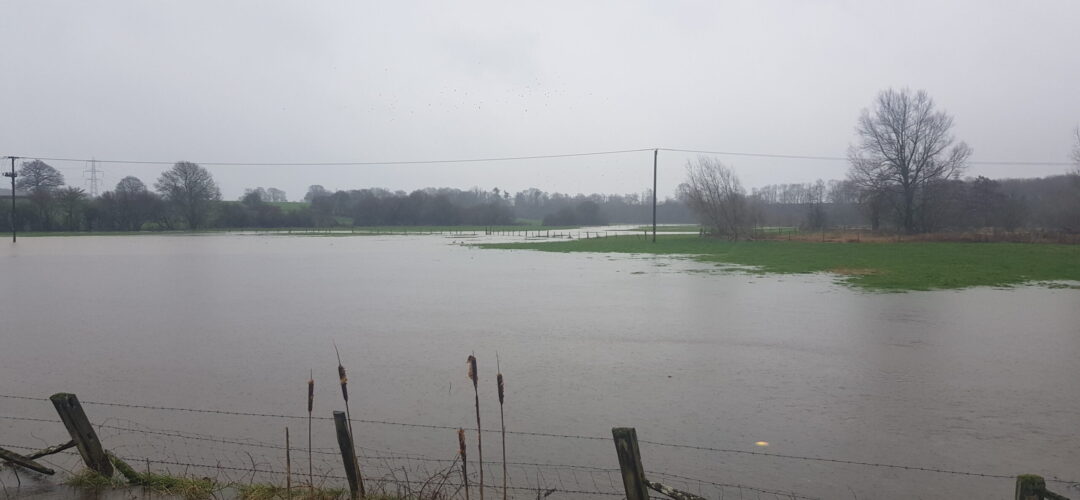
  • Taplins Farm Lane flooded again. We didn’t even attempt to drive through in a 4×4.
Taplins Farm Lane Flood. #StormDennis.

Taplins Farm Lane Flood

  • #StormDennis also flooded Pale Lane and the fields either side. The west side is also supposed to be SANG for the proposed Shapley Heath development.

This latest flood comes in addition to the other floods we have recorded in the area. We have recorded flood events on 15 January 2020 (#StormBrendan), 20 December 2019,  4 February 2019,  in April 2018 and three times in 2016 alone. Evidence documenting the 2016 flood events can be found here (4 Jan) , here (7 Jan)here (9 March on Station Road) and here (28 March due to #StormKatie).

The Whitewater Valley Society have also reported that North Warnborough has been badly hit.

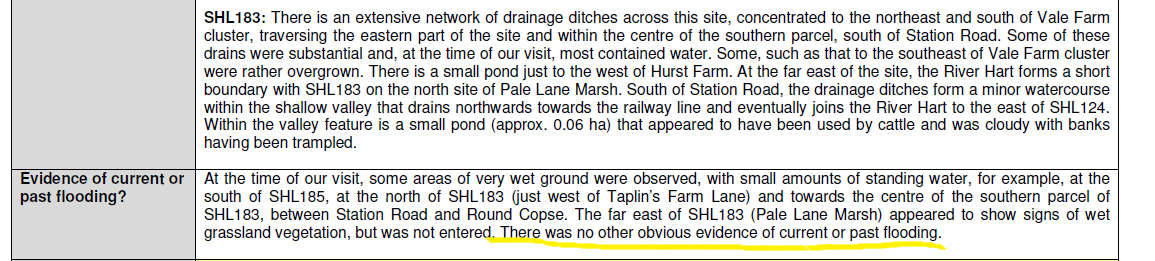
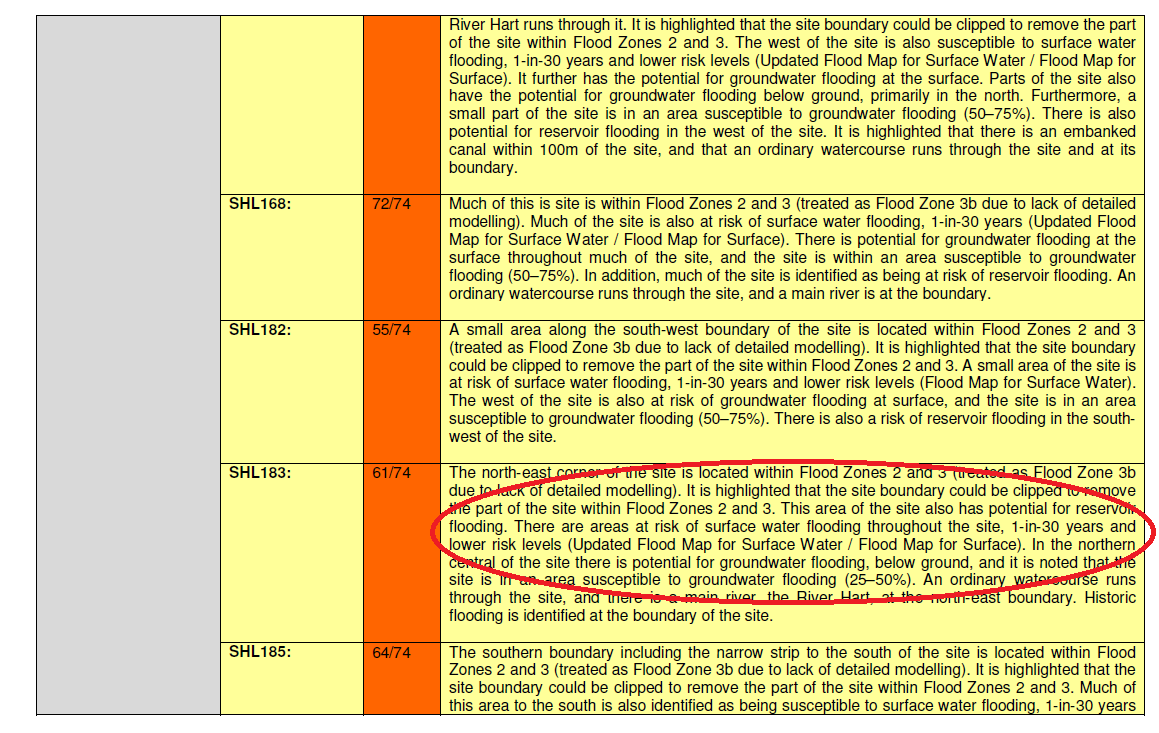
The actual weather has once again refused to comply with the flood assessment carried out for Hart Council as part of its evidence base for the Local Plan. The sustainability assessment claimed:

There was some evidence of wet ground at the far east of SHL183, but “no other obvious evidence of current or past flooding”.

Winchfield Strategic Assessment - Flood Risk 1

The detailed assessment also said there’s only a one in 30 year chance of surface water flooding.

Winchfield Strategic Assessment - Flood Risk 3

As far as we can tell, the road through the proposed development area and all roads out of the area were affected by the floods. Both SANG areas were also flooded.  When will Hart District Council see sense and abandon this daft project?

Hart Local Plan Immediate Review

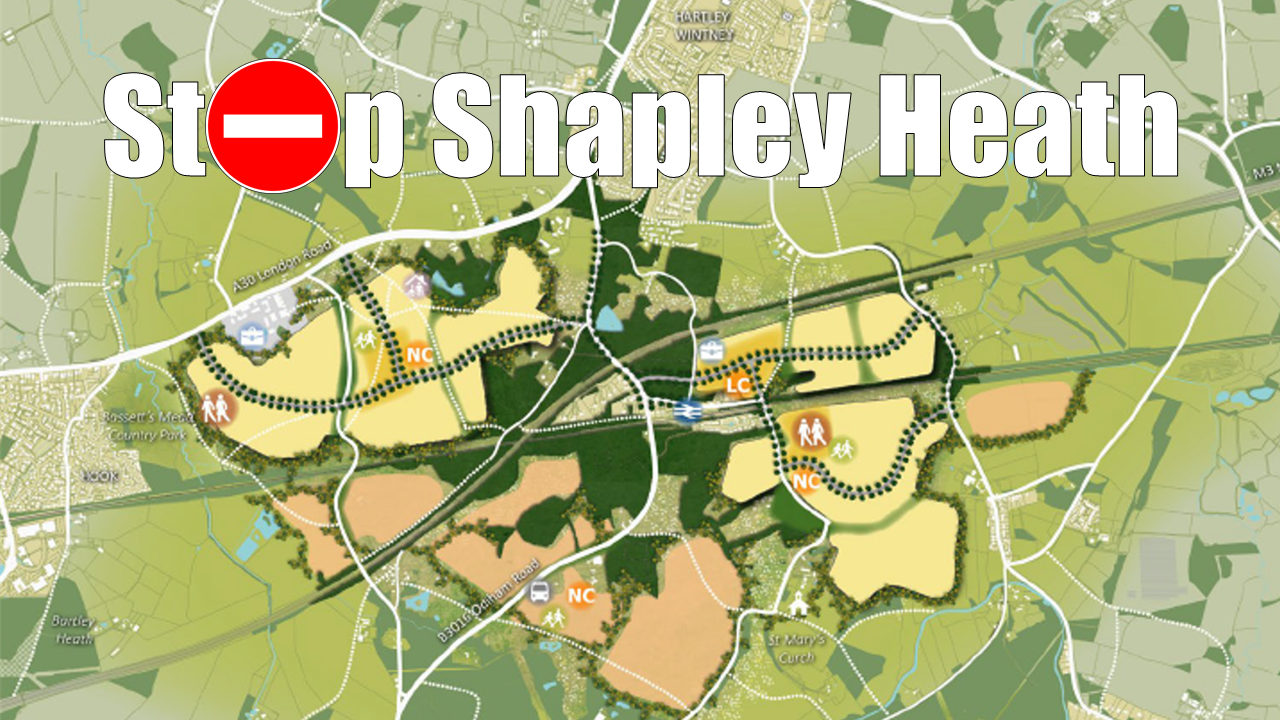
Stop Shapley Heath

Stop Shapley Heath – Hart Local Plan Immediate Review

The adoption of the Hart Local Plan is anticipated in February or March 2020. The council has conceded in its main modifications to the need for an early review of the Local Plan in certain circumstances (see MM121). We support an immediate review of the Hart Local Plan, once adopted.

We think the following objectives should be set:

  1. Build what we need, no more, no less.
  2. Avoid any new settlement or large scale green field development. This means we should not build Shapley Heath, Rye Common or West of Hook.
  3. Focus on brownfield development to revitalise our urban centres by delivering better health, community and cultural facilities.
  4. Proportionate development within each parish.

We believe this can be done, and this post explains the first stage of how we do that.

Hart Local Plan Housing Delivery Test

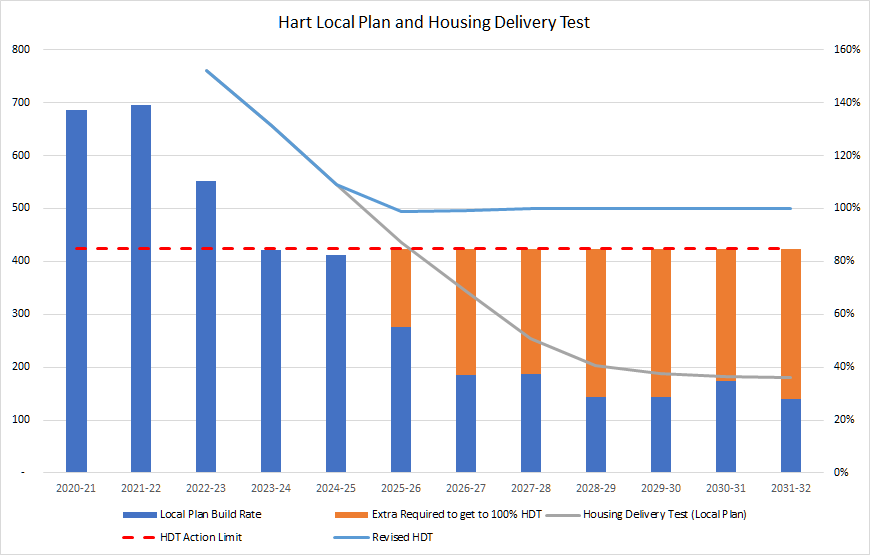
Before we start, we need to acknowledge a weakness in the Local Plan that will shortly be adopted. The Government have imposed the Housing Delivery Test (HDT) on all councils. The HDT aims to maintain a steady supply of housing by forcing councils to keep their rolling 3-year delivery in line with the average required rate. The Hart Local Plan will run into trouble with the Housing Delivery Test (HDT) around 2025/26. This was covered by a question to the full Council meeting in July 2019. This effect might be delayed or reduced if some or all of the large developments underway slip their delivery schedules.

But, if places like Hartland Park and Grove Farm stick to their delivery schedules, we will be running short of housing in 2025/26. To rectify this, pass the HDT at 100% based on the 423 dwellings per annum (dpa) imposed by the Local Plan, we will have to build an extra 1,700 houses over the period to 2032.

Hart Local Plan Immediate Review

Hart Local Plan and the Housing Delivery Test

Some council members may use this as a justification to pursue Shapley Heath Garden Village. We have already shown that Shapley Heath will deliver far more houses than we need, and unnecessarily urbanise the district.

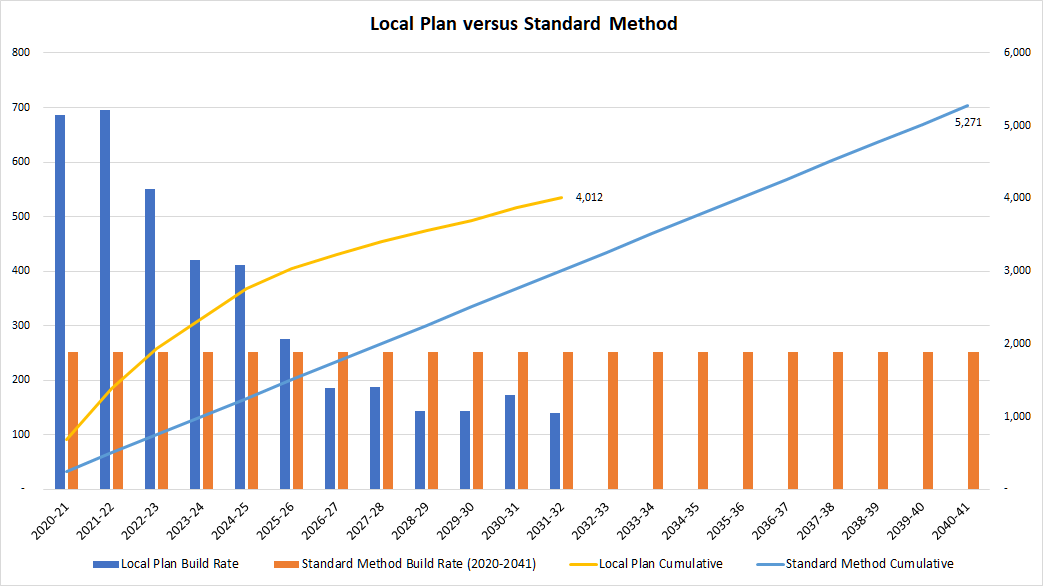
Hart Local Plan versus the Standard Method

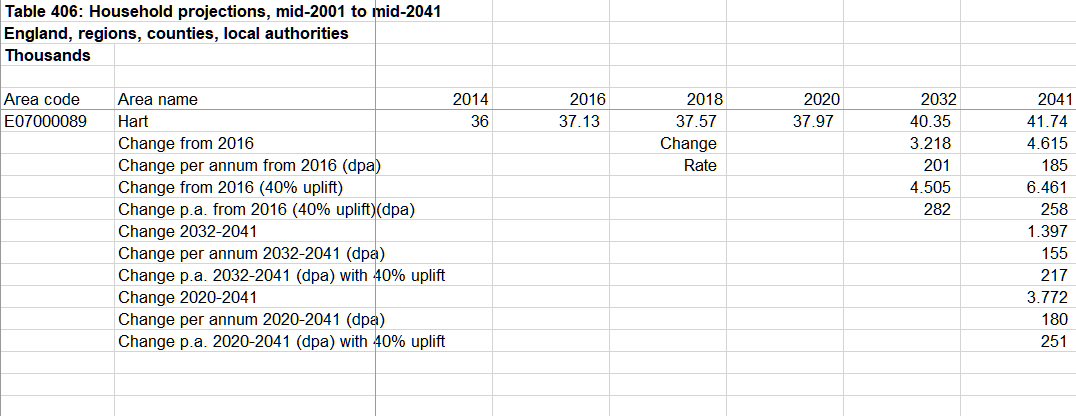
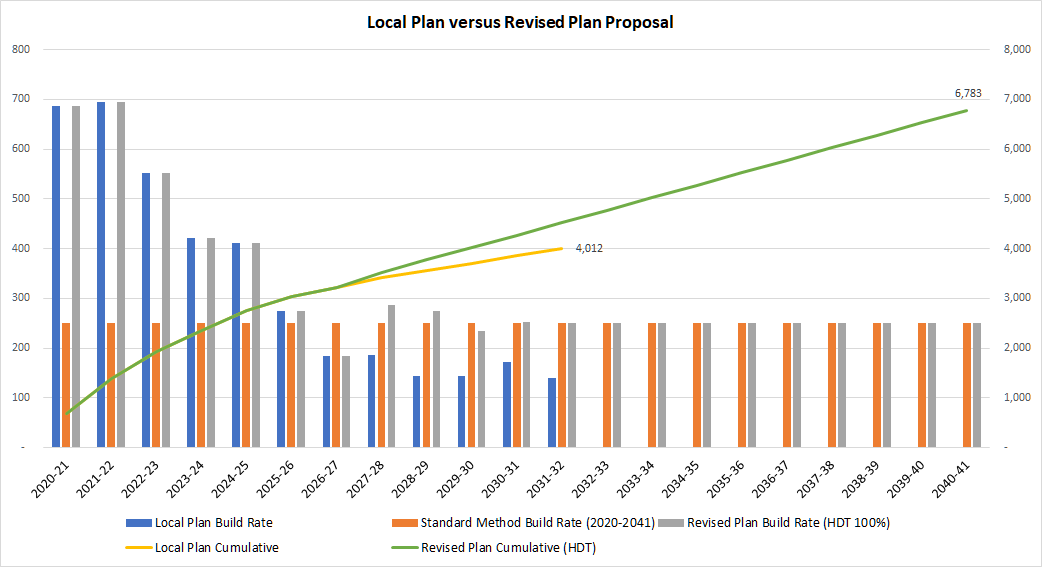
However, the Local Plan was examined under the (old) SHMA method. This, together with the alleged unmet need from Surrey Heath, resulted in a housing target of 423dpa. But, under the new standard method Hart’s housing requirement from 2020-2041 is only 251dpa (including a 40% affordability uplift).

Hart Household Requirements 2016-2041

Hart Household Requirements 2016-2041

Hart District Build Requirements under various scenarios

Hart District Build Requirements under various scenarios

This results in a total requirement from 2020-2041 of “only” 5,271 houses.

Hart Local Plan Immediate Review

Hart Local Plan versus the Standard Method

Revised Hart Local Plan to meet the Housing Delivery Test

However, any revised Local Plan would also have to meet the HDT. This would result in a total requirement of 6,783 houses over the period 2020-2041. The Local Plan has already identified 4,012, leaving 2,771 to find.

Hart Local Plan Immediate Review

Hart Local Plan versus the proposed Revised Plan

Hart Local Plan Immediate Review

So, the challenge from a Hart Local Plan immediate review is during 2020 develop a vision for Hart in 2040 to:

  • Deliver the 2,771 houses we need at a steady rate
  • Revitalise our urban centres
  • Proportionate development across remaining parishes to make up the difference
  • Protect the green spaces that make Hart an attractive place to live
Hart Local Plan Immediate Review - 2020 Vision for Hart 2040

2020 Vision for Hart 2040

We believe this can be done. We will work on how this might be done in subsequent posts.

This is another of our posts showing:

  • What is Shapley Heath, explaining its location and scale?
  • All the reasons why Shapley Heath Garden Village is a bad idea
  • An outline of an alternative approach to long term planning in Hart

The master page containing all of these posts can be found here. A link is also provided in the navigation at the top of the page.  Please do keep an eye out for further updates and share them with your friends.