We Heart Hart has been quiet for a while, because there has not been much to do. But Murrell Green has reared its ugly head again, so it is time to return.
What is the Murrell Green Development?
Developers have submitted a planning application to deliver up to 2,160 dwellings at Murrell Green mostly on the land between the A30 and the railway line between Hartley Wintney and Hook. This is 26/01201/OUT on the Hart planning portal. See Figure 1 for the Master Plan.
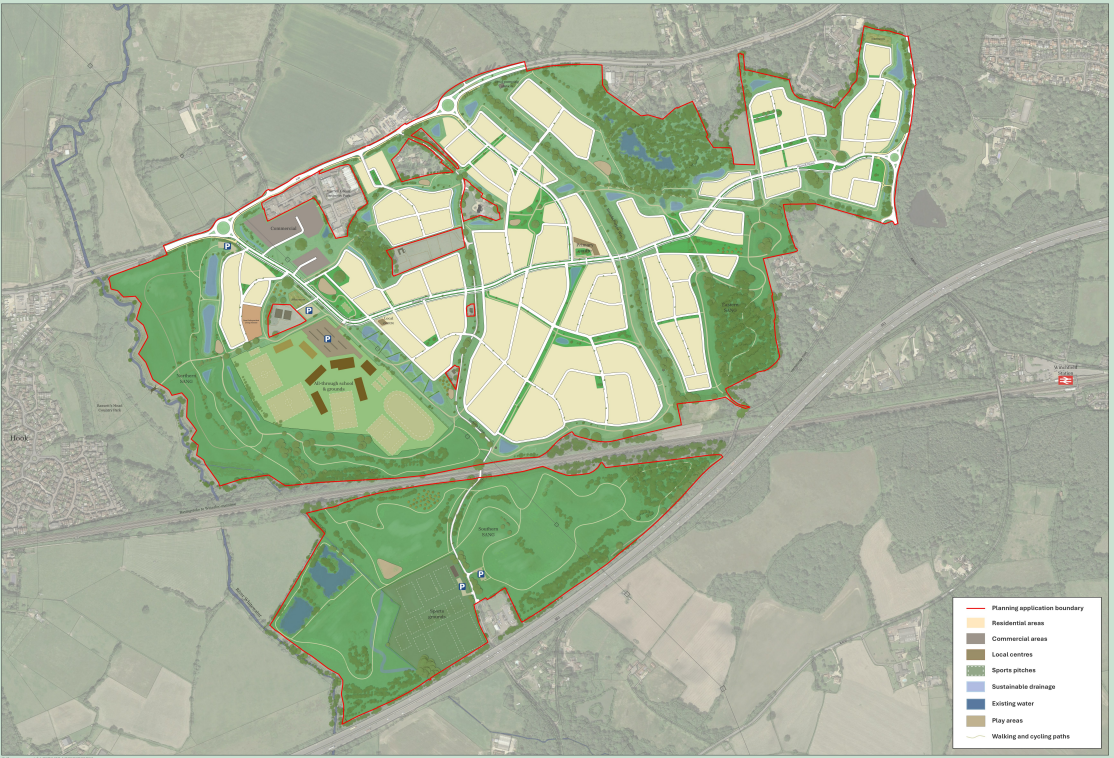
Figure 1 – Murrell Green Master Plan
This latest proposal covers a much larger area than the earlier proposal put forward in 2017. This proposal covers 184 hectares (455 acres) or the equivalent of 258 football pitches – a huge area. The application form proposes is for a total of 2,160 dwellings broken down into 1,188 market units, 562 units for social rent, 302 affordable ownership dwellings and 108 self-build. This is roughly the scale of the current Hartley Wintney village which is about 2,300-2,400 households of the 2,600 households in the parish.
The proposal also includes employment land for commercial and business uses, space for a local centre and a larger primary centre to accommodate shops and community uses and potentially healthcare. The proposal also includes provision for a nursery/pre-school, 3-form entry primary school and an 8-form entry secondary school.
Some of the existing green space is also to be designated as a Suitable Alternative Natural Greenspace (SANG).
Why is Hart Vulnerable?
Hart does have a local plan in place running to 2032. However, much of the development in the plan was front-end loaded and the Labour Government increased Hart’s Local housing “need” to 771 dwellings per annum from the Local Plan figure of 423 dpa. The combination of the front-end loading of the Local Plan, the extra housing “need” and the Council’s lackadaisical approach to reviewing the Local Plan means Hart no longer meets its 5-year land supply target.
Moreover, back in 2017 the Council appeared to be edging towards favouring the earlier Murrell Green development.
Grounds for Objection
Despite Hart being vulnerable, there are still several grounds for objection to the proposal. Readers may wish to use these ideas for inspiration for their own objections that have to be made to Hart Council by 13 August 2026. In summary the grounds for objection are:
- Landscape, Character and Coalescence
- Environmental
- Transport and Traffic
- Infrastructure and Local Services
- Economic Viability
Landscape, character, coalescence
The rural nature of the fields between Hook and Hartley Wintney are almost all developed under the proposal that effectively leads to coalescence of Hartley Wintney and Hook. The huge size and scale of the development is out of character to the local area.
The proposal lies entirely outside any defined settlement boundary and is therefore in the open countryside. Policy NBE1 (Development in the Countryside) of the Hart Local Plan states that development in the countryside will only be supported in a limited number of defined circumstances. A major new settlement of 2,160 dwellings does not fall within any of those exceptions.
Policy NBE2 (Landscape) requires development to protect and where possible enhance the landscape character of the District. The proposal would fundamentally alter the rural character of the land between Hook and Hartley Wintney and would result in the physical and visual coalescence of the two settlements.
Key View 3 from the B3016 in the Winchfield Neighbourhood Plan is violated. The spirit of Distinctive View E in the Hartley Wintney Neighbourhood Plan is also violated which calls for the preservation of the rural approach to the village and calls for coalescence to be prevented.
I therefore object on the grounds that the proposal is contrary to Policies NBE1 and NBE2 of the Hart Local Plan and the relevant policies of the Winchfield and Hartley Wintney Neighbourhood Plans.
Environmental
About 115 of the total 184 hectares is classified as Best and Most Versatile land (Grade 2 or 3a). This land would be lost to development in contravention of NPPF paragraphs 187 and 188. The Environmental Statement non-Technical Summary (p32) within the Murrell Green planning application states the loss of so much land to development will be a permanent major adverse effect.
The proposal identifies 66 Sites of Importance to Nature Conservation (SINCs) within 2km of the site, with seven of them within the site boundary. There are also six Sites of Special Scientific Interest (SSSIs) within 2km and the site is within 2km of the Thames Basin Heath Special Protection Area (SPA). Adding 2,160 extra dwellings in the area will no doubt put all these sites under stress.
The mitigation is to propose 58 hectares of Suitable Alternative Natural Greenspace (SANG). However, much of the SANG is placed on former landfill (see section 4), see Figures 2 and 3.
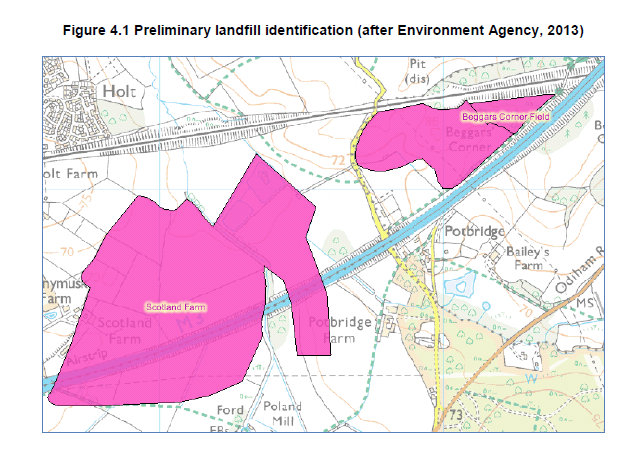
Figure 2 – SHL 167 former landfill site Beggars Corner
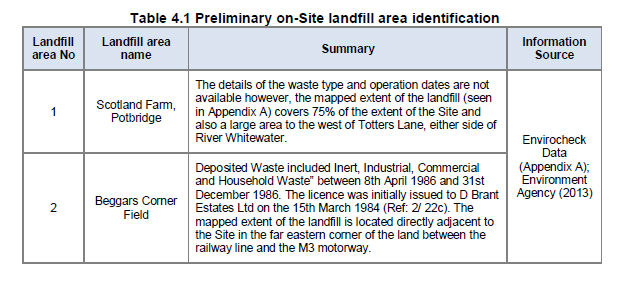
Figure 3 – SHL 167 Landfill details Beggars Corner
It is not known what is in some of the landfill and at this stage, the developer has not carried out detailed ground investigations. This presents a risk to future users of the SANG.
The claims on Biodiversity Net Gain (BNG) are frankly laughable. The proposal claims that gains will be made in all three areas: habitat, hedgerow and watercourse units (see Figure 4).
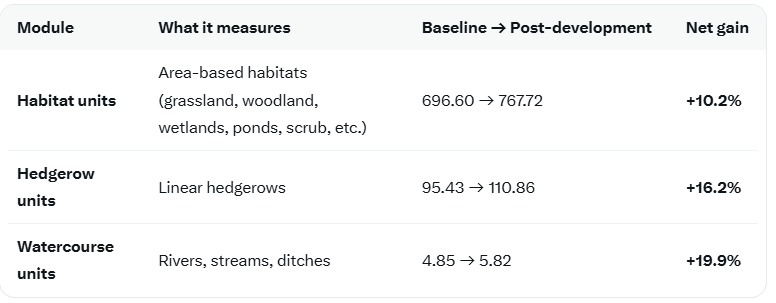
Figure 4 – Biodiversity Net Gain Claims
The proposal starts with a baseline of 696.6 habitat units in its baseline assessment. It its stage 1 assessment (section 2.5.3) it admits 534.07 of those units (essentially the fields) will be lost. After allowing for improvements to the SANG, the loss falls to 196.15 units, although it has to be said that most of the area remains as grassland as before and the proposed orchards are not visible on the map. Then the whole-site proposal miraculously increases the habitat units to 767.72, an increase of 10.2% without giving an itemised list of how they achieved this. By pure coincidence, they have to achieve more than 10% net gain across all three modules to meet planning rules. This looks like a huge fudge that does not stand up to scrutiny.
In addition, it appears that the only access to the southern SANG, south of the railway line is via the very narrow Totters Lane over the railway bridge. It is not at all clear the road and bridge can handle the extra traffic.
Policy NBE3 (Thames Basin Heaths Special Protection Area) and Policy NBE4 (Biodiversity) of the Hart Local Plan require development to protect and enhance biodiversity and to ensure no adverse effect on the integrity of the SPA. While a SANG is proposed, significant parts of it are located on former landfill of uncertain composition, and the Biodiversity Net Gain calculations appear to rely on optimistic and poorly evidenced assumptions to reach the statutory 10% target.
I therefore object on environmental grounds, including conflict with Policies NBE3 and NBE4 of the Hart Local Plan and the NPPF.
Transport and Traffic
The Murrell Green proposal includes the provision for two new roundabouts and a new T-junction on the A30 and a new roundabout on the B3016. Of course, the addition of 2,160 extra houses, probably over 4,000 cars will increase traffic on both roads leading to more congestion in Hartley Wintney and Hook. No mention is made of the need to improve the junctions of the B3016 with the A30 and A287, or the railway bridge on Totters Lane. Both are currently difficult T-junctions and will no doubt require improvement or converting to roundabouts to remain safe. The developer has not put a cost on the required improvements. The developer only commits to “proportionate contributions”.
The original 3-way roundabout at the A30/A327 junction cost £2.5m in 2015. With inflation that would probably cost £3.5m in today’s money. The proposed T-junction and three roundabouts plus the two extra probably required could easily amount to a cost of £20m.
No quantitative assessment has been made of the impact of this development on Winchfield or Hook railway stations. There is no assessment of the current or future capacity of mainline trains up to London, peak hour passenger demand, platform capacity or car park capacity. It is proposed there might be electric bike hire or a 30-minute bus service to connect to Winchfield station. No financial commitment has been made for any physical works that may be required. We might expect car park and station improvements to cost £8m.
I therefore object to the Murrell Green planning application on the grounds the transport and traffic proposals are inadequate and unfunded.
Infrastructure and Services
The developer has made provision for some non-domestic buildings on site but has not made explicit provision for a new doctor’s surgery. There is only a vague commitment to providing “proportionate financial contributions” for primary care. This is insufficient as the Whitewater Health serving the public from sites in Hook and Hartley Wintney is already overstretched. The cost of a proper surgery could easily run to £3m.
The Murrell Green planning application identifies gaps in capacity for both water provision and disposal of foul sewage. And proposes off-site reinforcement for water and a new foul water pumping station. The responsibility for funding much of this work will fall on the water companies. However, the cost of the on-site pumping station would fall on the developer and we might expect the cost to be around £5m.
As previously documented, there is a high-pressure gas main running through the site. This time the developer is planning to divert the gas main but is only budgeting £2.1m +VAT for the works. This is the same amount as they suggested in 2017, so already looks like a low-ball estimate. Data from the US shows the cost of pipelines around $12.1m per mile. The proposed diversion is about a mile long, so this suggests a cost in the region of £9m, probably higher in the UK.
The Master Plan shows land provision for an “all-through” school consisting of a nursery, up to 3-form entry primary school and an up to 8-form entry secondary school with up to 1,200 places. In the Heads of Terms, the developer only commits to providing “proportionate financial contributions” with no actual figure mentioned. However, North Whitely School (900) places cost £52m. Scaling this up to 1,200 places gives £69m. Adding extra for the 630-place primary school and nursery could easily take the total to £110m. Relying solely on “proportionate contributions” creates a significant risk that the school will be under-funded or delayed.
I therefore object to this proposal on the grounds that the local infrastructure cannot cope with the additional 2,160 dwellings and the mitigation is inadequate and underfunded.
Economic Viability
The developer is listed as Lightwood Land Limited in the application. According to Companies House, this is a micro-company with just £256K in net assets in the latest accounts up to November 2024.
A project of this scale could easily have a Gross Development Value of over £1bn, well out of reach of such a small company. If we assume GDV of £1.1bn and a gross margin of 18%, the gross profit for this scheme would be in the order of £200m.
Now let us consider the cost of the various infrastructure promised and required to make this development work. Adding up the items above gives a total of £155m, see Figure 5.

Figure 5 – Estimated Infrastructure Costs (£m)
In other words most of the expected gross profit will be consumed by the cost of infrastructure. We can therefore expect the developer to propose “proportionate financial contributions” well below the full cost, meaning much of the cost will fall on the taxpayer or the infrastructure will not get built at all. I therefore object to this proposal on the grounds that it is not economically viable.